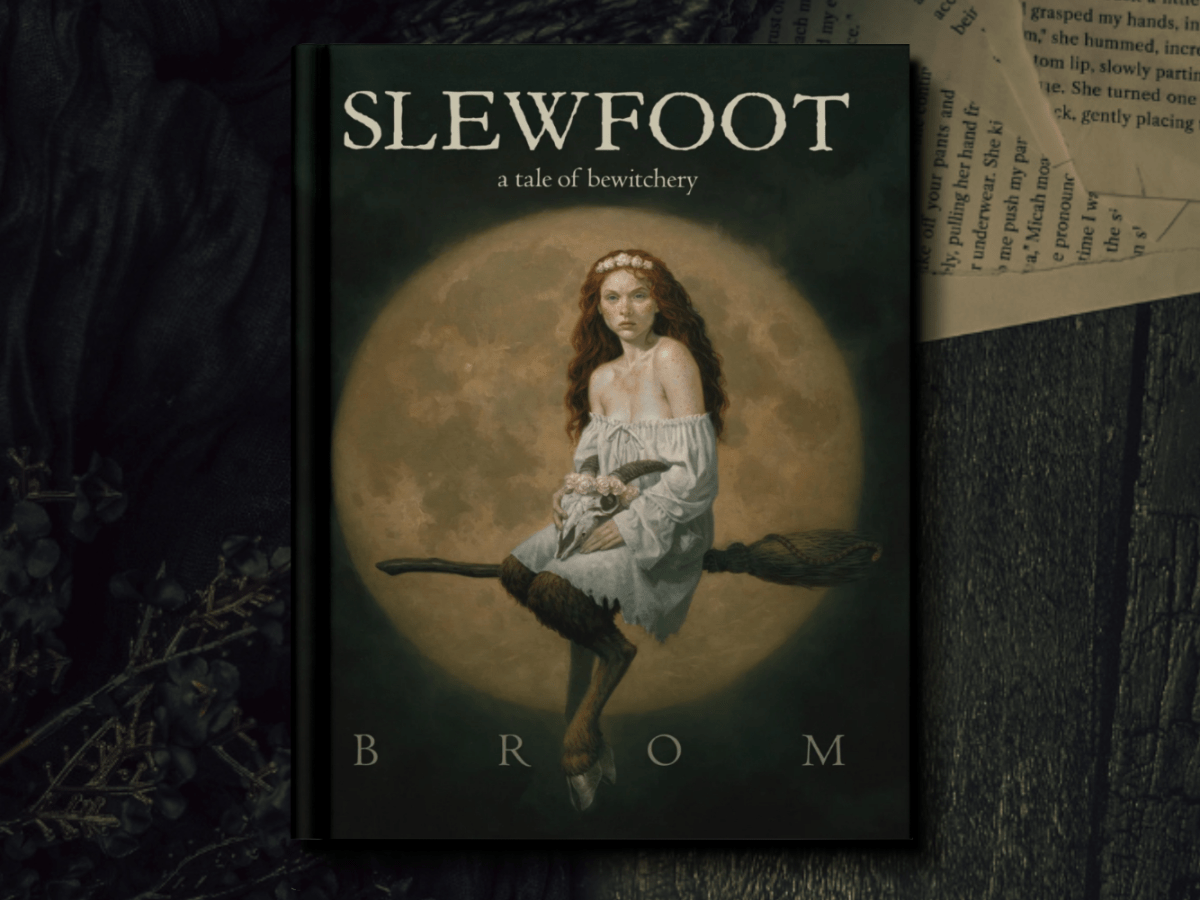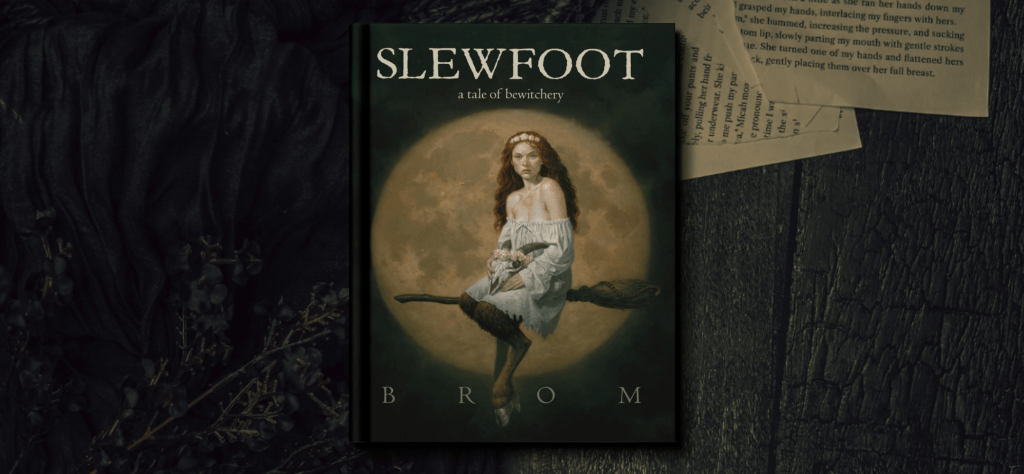
Title: Slewfoot: A Tale of Bewitchery
Author: Brom
Release Date: September 14th, 2021
Pages: 305
Genre: Horror, Historical Fiction
GoodReads Rating: 4.20 ★
My Rating:
I’ve been hearing praise for Slewfoot since I started reading again in 2023. I was always going to get around to it, and I even checked it out of the library sometime last year. I just ran out of time to read it before I had to return it. This time, I placed it on hold because I thought it would be my book club’s pick for the month of June; however the votes swerved in a different direction at the last minute. My hold still came through, and I decided it was finally time to dive in. With one of the best GoodReads ratings I’ve ever seen and a fantastic cover, I was bound to be in for a good time.
Abitha did not grow up as a Puritan, but since her marriage to the gentle colonist Edward, she has had to adapt to their rules and laws: dress modestly, attend worship, and always hold her tongue. But Abitha has a wildness within her that she struggles to tame, and her fire is bringing Edward out of his shell, too. Then, he unexpectedly dies under mysterious circumstances, leaving Abitha alone on their homestead and fighting to keep the land out of the hands of Edward’s greedy brother, Wallace.
If Abitha can bring in the harvest, she can keep the homestead that she and Edward worked so hard for, but she’s a woman alone during the worst drought she’s ever seen. She begs for help to save her crops, and something ancient answers.
Slewfoot, or Samson as Abitha dubs him, is newly awoken from a deep sleep. He doesn’t know anything about his purpose or his past, only that he is hungry for blood. Something deep inside him suggests that he could be more than the killer his instincts drive him to be. He has a connection with the land that could save Abitha, and her kindness and devotion could save him from the darkness that attempts to burrow into his soul. Is she engaging in deals with a devil? Or could Samson be the answer to her prayers?
Characters & Writing
Abitha was a protagonist who was very easy to root for. I liked her strong will, and I liked her sense of justice. I think using Edward as the vehicle to show her strength and care was an excellent choice. She doesn’t like to see him taken advantage of, but because of her position in their society, she can’t stand up for him. Instead of just giving in and allowing Edward to be hurt, she gently coaches him about how to stand his ground and to believe in his own strength.
I also liked the elements of her backstory that explored her divergence from a pure Christian faith. Abitha’s mother was a “magic” woman who made little charms and healing remedies, and she taught Abitha to access that as well. So when Abitha sees Samson, she is in conflict with herself. One part of her has been taught that a creature like this is Satan, Slewfoot, the Devil. The other part of her was taught about forest gods and the Wildfolk. So, she isn’t the classic victim being seduced by the devil. Abitha does exist in a level of denial about God being the one who sent Samson, but it never really feels like she’s being too disingenuous with her feelings about him.
Samson is the name Abitha gives to “Slewfoot.” He is, unfortunately, an extremely boring character for a very long time. It’s not that Samson’s internal conflict isn’t interesting; it’s just that the way he processes this internal conflict is not through any action or metaphor. He just thinks. For pages and pages and pages, he thinks and questions his purpose and his path. It makes his chapters extremely boring compared to Abitha’s, especially before they meet. The arc that he goes through doesn’t necessarily follow the standard “character who was told they were evil chooses to be good” trope, which does make it much more interesting to read about. I liked learning about Samson’s powers and his history, too. Who he ended up being and his transformation throughout the story was emotional. It just takes so long to get there.
Wallace is Edward’s brother and the primary antagonist of the novel. He’s the one threatening to take back ownership of the homestead if Abitha doesn’t make the final payment to him. I really liked how his relationship with Edward subverted my expectations. I was convinced, after the two had been in conflict for the first couple of chapters, that Wallace would have something to do with Edward’s demise, or at the very least with moving or hiding his body, but despite their contentionWallace doesn’t do anything to physically harm Edward.
Wallace is definitely what I would consider evil. He’s conniving, dishonest, sexist, and a hypocrite, but I did still end up feeling a kernel of pity for him. His plans all come from the desperation of not wanting to lose his own home due to his bad investments, which is a totally understandable motivation. It still doesn’t excuse any of his actions, and throughout the novel, that motivation evolves into hatred of Abitha. Wallace feels humiliated by her, and he uses every weapon at his disposal to try to bring her down to where he believes she should be, including his religion and his relationships with powerful people.
The Wildfolk were interesting, too. Forest is the only one who spoke, so it was a bit difficult to glean any individual personality from the other two. I did like that Forest had his own agenda, and despite being a small, cute creature, he had a vicious streak and was willing to do anything to get what he wanted. The townspeople fall a bit into that same category, but I appreciated that they weren’t a monolith in their hatred of Abitha. A few characters treated her fairly and kindly, which makes it all the more tragic when they’re caught up in the chaos.
I’ve read a decent amount of historical fiction, and the number one thing that will throw me out of a story set in the past is the language that is used in both dialogue and prose. Sometimes an author’s modern voice will sneak into the text, even unintentionally. Brom does an exceptional job at keeping everything feeling very time-period appropriate. Abitha never felt like an overly modern protagonist, despite her desire for freedom and personhood that would not typically be granted to a woman during this time period. It made it very easy to indulge in the atmosphere that was being created because there were no bumps that caused me to pause and evaluate.
The prose is very descriptive and flowery, bordering on purple at times, but I never found it too distracting. Instead, it built an ambience that pulled nature into the forefront of the reading experience. Here’s a simple quote, as an example.
“The towering trees grew ever denser as she went, leaning in on her from either side, blocking out the sun—a twisted tunnel of branches and leaves and gnarled roots that felt ready to swallow her at any moment.”
Slewfoot: A Tale of Bewitchery (2021)
Samson is deeply entwined with the natural world, so I think spending the time to build the reader’s relationship to the nature around them— the trees, the wolves, the bees— builds the relationship with Samson and makes him more familiar. The familiarity brushes up against some of the more violent actions Samson takes, so tension is created with this constant push and pull. Is Samson evil? Is Abitha safe? We don’t really know for much of the narrative. It works really well within the context of the story.
Something that I thought was a nice, layered detail in the writing was the progression of Abitha through her clothing. At the beginning of the story, she is trying to dress like all the other women in her Puritan village: apron, shoes, bonnet, etc. Despite this, the reader is immediately given the idea that Abitha is different because her curly, red hair refuses to stay tucked underneath the bonnet, symbolizing the idea that she doesn’t fit into the community. Throughout the story, as she works the farm and interacts more with Samson, she loses more of these restrictive clothing items. First the bonnet, then the shoes, until finally, at the peak of her “bewitching,” Abitha embraces the natural world and demonstrates it through her nudity. It’s a great little metaphor that isn’t overly spelled out for the reader!
Plot & Pacing
The pacing of this book is interesting because the first 25% is extremely slow. It does the proper functions of a story introduction. It introduces the reader to Abitha and her relationships, establishes the village and some of the rules and rituals Abitha must follow, and introduces the mystery of Samson. All of this is entirely functional and normal, but I think what drags the story down a lot in this first quarter is Samson’s inner thoughts, inner world, and dialogue.
Samson doesn’t know who he is, but he also doesn’t really care to learn who he is from the Wild Folk. It’s somewhat understandable that he wouldn’t trust them because Forest is acting a bit shady and demanding things that Samson feels are not aligned with his true character. However, Samson goes on this really vague journey to another dimension, maybe? It’s quite early in the story to be leaving the realm of reality this entirely. I think he… follows the ghost of a mammoth into the great beyond? It’s very odd, and at this point in the story, I wasn’t invested enough in Samson to care. I wanted to know what Abitha was doing!
Once the two of them start interacting, the pace and intrigue of the story pick up. As I’ve said, a lot of the interest in the story exists between the tension as the reader wonders if Samson is evil or if Abitha will be able to grow her crops and save her home. The way these events unfold almost has a true tragic trajectory. So many characters in Slewfoot bring about their own demise because of the actions they take, which makes the story feel quite satisfying. It ties into their religion as well. Puritanism plays a large part in the story, and Puritans believed that their actions would lead to their damnation if they didn’t repent and turn from wickedness. The story between the town and Abitha is a microcosm of that, punishing the hypocrisy of those who claimed to be righteous. It’s compelling.
There were a few parts of the plot that left me a little bit puzzled. The first is Edward. It’s not a spoiler to say that he dies; it’s in the GoodReads summary. However, Edward haunts the narrative in both a figurative and literal way. Samson needed blood to awaken from his sleep, and Edward’s blood ends up being part of that ritual. It’s implied that the part of him that is Edward still has a fondness for Abitha and a curiousity about her. I think this could’ve been such an interesting part of the story, especially because Edward is described as a bit of a repressed, downtrodden man. The beast could’ve made part of him bolder, and it could’ve created more of a bridge for Abitha and Samson to fall for each other. That doesn’t really happen, though. The connection between Samson and Edward is dropped very early into the story, and instead, Edward is a literal ghost. He doesn’t have much of a function within the narrative, barring being a bit of a cheap spook, and I feel like that was a missed opportunity.
The story with the Wild Folk, Forest, River, and Sky, and the Paw Paw tree was also just… so much. It wasn’t necessarily bad, but I do think the story would’ve been almost identical if most of those elements were removed. They’re trying to turn Samson down the path of being a killer for their own purposes, but I wouldn’t really have been seeking an explanation if he just had the urge to kill. The story could still follow the same arc for Samson, and it would’ve streamlined the plot. I’m not saying that these elements were uninteresting or that every story has to be peak efficiency. There’s just a lot of back and forth about these things when the reader mostly knows where the story is going to end up.
The guy that was trying to capture Samson was also relatively useless overall. I think his primary function was to get Samson away from Abitha for long enough that the whole witch trial can happen, but it’s a lot of the page count that I skimmed because it was all a bit boring. The idea of the character and his design were very cool, but I just wasn’t interested, and I think that section massively slowed the pacing. I spent the whole time hoping to get back to Abitha as soon as possible to continue the actual story.
Horror Elements
I was really interested in the portrayal of the witch trials in Slewfoot. I’m not sure if they were accurate, but at the very least, I am aware that some of the elements were true. Witch marks were a real thing, I believe, where skin blemishes were believed to be marks of the devil. I also think that “crushing” was a real torture method used on suspected “witches” as a way to draw out false confessions. Witches also weren’t actually burned at the stake in the United States, so I appreciated that the story used a more historically accurate form of execution.
Most of the horror elements ramp up near the end of the story, though there are little spikes of horror throughout the rest of the story. Abitha’s ending was well-written and quite satisfying to me. There were a lot of good, creative kills and violence in the climax, though it did come across as a bit choppy and episodic. I do understand that it would be far too convenient for each attack to happen at the same time, in the same place, but for several chapters at the end of the book, the point of view jumps between so many characters in so many locations that it made me a bit confused about the layout of the town. I don’t think this structure is uncommon in horror books, but I think I noticed it more with Slewfoot because of how the rest of the story was paced with slower, more smoothly flowing scenes.
All of the artwork in this book is also fantastic. Each chapter features a black-and-white illustration that’s on theme with the subject matter of the chapter, and there were several gorgeous, full-color paintings of the characters at the back of the book. I got my book from the library, as I do with most of my books, but I would consider buying my own copy just to have some of this artwork! I also think it’s interesting to see what the author was thinking the characters looked like, especially with characters that were slightly harder to picture, like Forest. I almost wish I had known to look at the illustrations first because it really changes the way I viewed the characters.
Recommendation
I would recommend Slewfoot: A Tale of Bewitchery. It’s always a bit odd for me to be recommending a book that already has such broad acclaim because why would my recommendation be different from any of the other hundreds or thousands of positive reviews for this book? But, in case you value my opinion above all others, I had a good time with this one. I would simply warn that readers who prefer a faster pace might end up very bored by the beginning of the novel. If you’re willing to settle in for a winding opening, I think you’d have a good time.
Does the Cat Die?
Yes, there is a cat named Booka in the story. He’s got a crooked tail and only one eye. He does unfortunately die, and in a way that is quite cruel and upsetting. He is avenged, but that’s little comfort.
Trigger warnings:
Animal death, animal cruelty, amputation, attempted murder, blood, colonisation, fire, gore, misogyny, murder, religion, sexism, starvation, suicidal thoughts, torture, violence.