

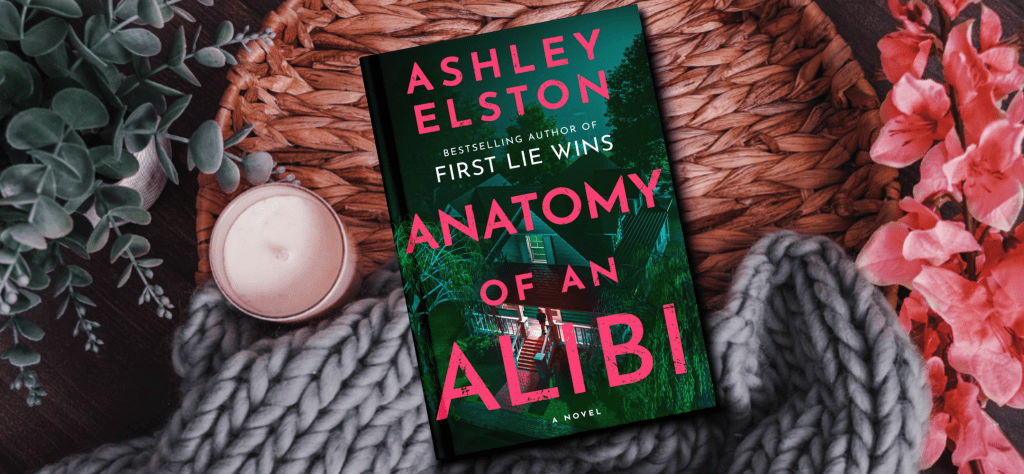
Title: Anatomy of an Alibi
Author: Ashley Elston
Release Date: January 13th, 2026
Pages: 340
Genre: Thriller
GoodReads Rating: 3.80 ★
My Rating:
I stumbled across Anatomy of an Alibi while I was browsing the new releases at my local bookstore, and I was immediately excited. First Lie Wins was such an intensely complicated thriller with a unique plot and twists I didn’t see coming, so I knew immediately that it was going on my TBR. This book was enjoyable, but it didn’t live up to the hype I set in my own mind. First Lie Wins is a tough act to follow, but Anatomy of an Alibi does try its best.
Camille Bayliss stands out in the run-down dive of Chantilly’s Bar in her glamorous designer heels, bright red lips, and sipping a Negroni. Patrons of the joint would definitely remember seeing her there, except it’s not Camille; it’s Aubrey Price, dressed as Camille.
These two women concocted a scheme that might get them both what they want. Camille is the daughter of one of the richest, most influential families in Louisiana, and she’s married to a rising star defense attorney, Ben Bayliss. But Camille wants out of the marriage. Ben tracks her every move through GPS, credit card transactions, and security cameras, and Camille is tired of it. She suspects Ben’s law practice isn’t as clean as it seems, but she has to prove wrongdoing to avoid ending up destitute due to an ironclad prenup.
Aubrey Price lives a tougher life. After a terrible night that completely upended her life a decade earlier, she built herself back up, working shifts at a bar and living with a group of mostly reformed low-level criminal offenders. However, when Camille walks into her bar and shows proof of Ben following Aubrey, she thinks he might know more about that night than he’s letting on. She’ll do anything to discover the truth of that night, even if it means teaming up with a rich snob like Camille.
Aubrey agrees to pose as Camille so she can spend twelve hours watching her husband for any sign of impropriety, and in exchange Camille will reveal everything she discovers. However, the next day Ben is found killed, and Aubrey fears that Camille might have used her to commit an untraceable murder. Aubrey has no alibi, but she’s inadvertently become Camille’s.
Characters & Writing
The characters each serve a function within the story, but some are definitely more frustrating than others. Camille Bayliss unfortunately comes across as kind of dumb. Her plans are quite shallow, and she doesn’t really think through any of the details. It didn’t bother me too much because the characters around her are moving and investigating in intelligent ways, but at multiple points I was rolling my eyes at Camille’s actions.
She’s also extremely passive as a character. Most of her time on the page in the first part of the book is literally spent sitting in an attic and watching other characters interact. It’s interesting because this is meant to be a part of her personality. Other characters point out that she’s passive, afraid, and relies on others to get her out of tough spots. This implies a “before” in her character arc, and I kept expecting that she would evolve away from that as the story progressed. Camille ends up being the exact same passive character by the end of the story, allowing Hank and her brother, Silas, to clean up after the whole mess. It was a bit disappointing.
I also ended up wishing that Camille was more suspicious. It’s a bit difficult to make that happen because we do read from Camille’s perspective, but Elston did a much better job of building the mystery around “Evie” in First Lie Wins. I never believed that Camille had anything to do with Ben’s death, and it cut away one of the biggest suspects from the story.
In comparison, Aubrey is much more intelligent than Camille, though she didn’t play her hand very well. At no point did Aubrey really try to make the “alibi” look legitimate, and so she gave away basically immediately that she and her friends were investigating. I would understand if she was just alerting Camille, but because of the surveillance that Camille is under from Ben, Aubrey is also alerting him that something is going on. She needs to keep her movements secret so that Ben doesn’t find out what she knows, whom she is talking to, and where she’s been; and while theoretically Ben believes her movement is Camille’s, her suspicious behavior doesn’t make her cover story any easier.
Aubrey is the catalyst for the mystery that unfolds, and I think her desire to investigate is fairly believable. I liked her drive to find answers and her level-headedness in the face of obstacles.
I also liked Aubrey’s house full of criminal friends. They made a fairly convincing found family, and I liked how ride-or-die they were for Aubrey. They were fun, and I appreciated that the story didn’t try to make any of them too deep. It would’ve been very tedious to keep track of so many characters if they were attempting to be more than the “functional” part they were made to play. Deacon is the only one of them I wish had a bit more character. He’s sweet, and he does have his own life going on behind the scenes, but he’s just as “functional” as the rest of the characters. Yet, the reader is supposed to get invested in the relationship between him and Aubrey. It just seemed like his world revolved around Aubrey a bit too much.
Hank is probably the character I liked the most. He’s just so tired, and so am I. He’s extremely good at uncovering information, and he’s one of the few characters that we immediately know is innocent. I liked that he was still suspected, though, because of the business he had with Ben. It gives him a solid motivation to investigate because he knows how easy it would be for him to go down for a crime he didn’t commit. It gets him involved with the other players in the story, too. Hank is the best at uncovering information, and I think he’s the most intelligent in terms of planning and putting together disparate clues.
Ben is the last character I want to talk a little bit about. There are some parts of his character that I really enjoyed. Early on in the novel, the reader discovers that Ben grew up poor and is now very wealthy, and I think he does act like it. There’s a certain level of insecurity he has in his home, business, and relationship that shows he is, or was, a person with a scarcity mindset. His relationship with Camille and her family’s influence is something he greatly values, so he goes to great lengths to keep them, including monitoring everything Camille does. That’s obviously a level of abuse, but I do wish he was even more evil. The reader learns a lot about Ben over the course of the story, and some of his shadiness is revealed, but everything he did was a bit understated in my opinion. I wanted to hate this guy, but I didn’t really get to do that. We’re told about some of the corrupt actions he’s taken, but see very little of it on the page. It left him, like many of the other characters, a bit flat.
The writing and atmosphere were fine. I consider the writing in most thrillers to be fairly utilitarian, and this one was no different. I don’t recall any specific moments of prose or metaphorical writing, but I don’t really believe that’s required for an effective thriller. I’ve said it before, but thrillers live and die on the strength of their plot and pacing. I did see some reviews talking about the author’s use of present tense, and that usually bothers me. However, I didn’t notice any instances that felt awkward or pulled me out of the story. That being said, there was a good amount of tension throughout the book. I’m not sure I ever really feared for the characters’ safety until the climax, but I did fear for their freedom. That was enough to keep me interested.
Plot & Pacing
The book is paced well. Moments of fast-paced action or stress are contrasted well with the slower, investigative sections. The reveals unwound at a steady pace, which I always appreciate. The use of multiple POVs in this book really worked in favor of the pace of twists because nearly every chapter could contain a new revelation without overwhelming any one character or storyline with information. Camille might be acting shady in Hank’s chapter, and then in her next chapter, it’s divulged that she’s acting strange because she met up with Aubrey. Then, in Aubrey’s chapter, we see the information she gathered previously. It hides the important information in several layers of character motivations without feeling like it’s being obscured arbitrarily.
The plot itself was interesting, though I would say it didn’t hit as hard as First Lie Wins. While Ben’s murder sets of the investigation in the present, it’s not really the mystery that most of the characters are looking into, besides Hank. Aubrey and Camille are both more invested in figuring out what happened ten years ago. I liked the idea of a conspiracy to cover up the crime, and the amount of characters involved makes that believable to me. Each tier of the conspiracy is explained and planned for, and it made the outcome more real.
I do wish that the “mistaken identity” plotline was more relevant. This is supposed to be a story about Aubrey posing as Camille, but basically every single character involved in the mystery knows that this is a lie, and the ones that don’t aren’t relevant. If these two characters really can pose as each other, why don’t they use that for more hijinks? It could’ve been really fun, and it could’ve given Camille more to do. As is, it’s dropped basically instantaneously.
Twists
The twists were a bit predictable for me, unfortunately, though First Lie Wins is a tough act to follow. The twists and turns in that story were so hard to predict that I barely saw any of them coming. In Anatomy of an Alibi, I did see most of them on the horizon; and on one hand, it’s good that these reveals are supported by textual information, but on the other, it made them a bit boring. The final twist was hard to predict, but I think that’s more a function of the character’s role in the story than clever subterfuge by the author.
My main gripe about the twists and story is actually in relation to the title and synopsis. I don’t think the story really has anything to do with the alibi that Camille and Aubrey crafted. It’s never really used to get the character into or out of trouble. Yes, the alibi does function as Camille’s excuse to the police about where she was when Ben was killed, but the police presence never really feels like an omniscient threat to either protagonist. I can think of one instance where Aubrey is suspected by the police, and it isn’t related to the alibi at all. It still could’ve occurred if neither woman participated in the subterfuge because it wasn’t based on police questioning or a slip-up in one of their interviews. It was just an anonymous tip via phone call.
The alibi doesn’t even really function in the “past” timeline either. Aubrey is not following the plan at all and is moving in a very suspicious way. Camille doesn’t find out any information about what her husband is actually up to through her spying. It’s just all so useless to the plot, and I should not be saying that about the central synopsis of the book. The rest of the story is good, and I enjoyed the way events unfolded. I’m just bothered by the idea of “the alibi” because that could’ve been an interesting story to see in action, and I just didn’t see it.
Recommendation
I would recommend Anatomy of an Alibi, as long as you just accept a lot of the craziness that can occur in thrillers. Convenient plot points, characters that are all lying, and some twists that stretch the bounds of believability didn’t bother me, but they might bother you. I thought it was a pretty standard twisty thriller that left me relatively satisfied, and that’s all I can really ask for!
Trigger warnings:
Murder, car accident, death of a parent, police brutality/corruption, alcohol, gun violence, violence, blood, stalking, emotional domestic abuse.





 A Literary Apothecary