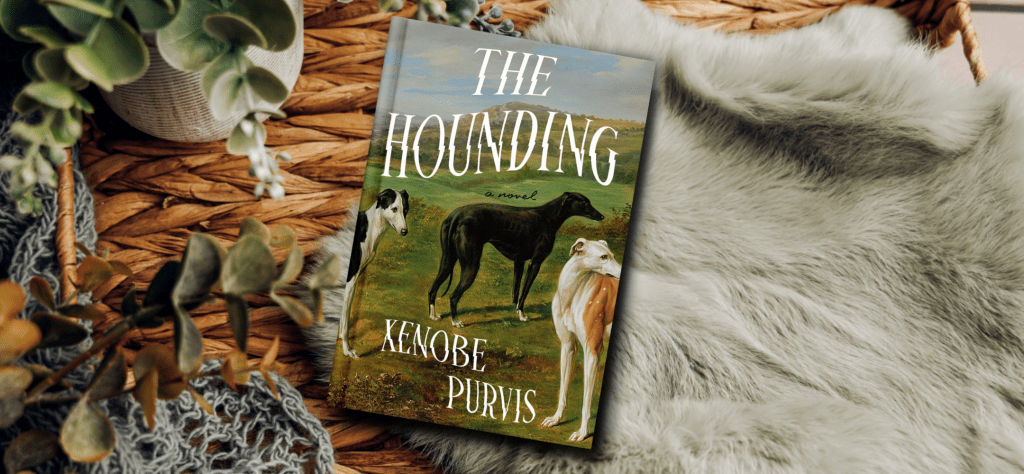
Title: The Hounding
Author: Xenobe Purvis
Release Date: August 5th, 2025
Pages: 240
Genre: Literary Horror, Historical Fiction
GoodReads Rating: 3.65 ★
My Rating:
There’s been an odd subgenre that I’ve seen emerging, or more so gaining popularity, in the last few years involving the relation of women to dogs. I really like this as a metaphor, regardless of the form, because the underlying symbolism is so powerful: something docile, domesticated, and typically controlled by men becomes ungovernable. The Hounding, in many ways, follows the path of the books before it. However, I do appreciate its differences.
It’s an extremely hot summer in Little Nettlebed. The river is lower than it’s ever been before, and the heat is enough to drive any man mad. But when one man claims to have seen something beyond the canny, the rumors in the village alight on the dry grass like a wildfire.
The Mansfield sisters are considered a little…odd. They rarely come to the village, choosing to remain on their grandfather’s land. They barely speak, never smile, and hold a certain coolness that makes people uncomfortable. The ferryman claims that he watched the girls, with his own eyes, transform into dogs by the riverbed. The townspeople are more than willing to believe anything that will justify their dislike of the girls, and their attitudes could turn dangerous at any moment.
The story is told through the eyes of five different characters, and while that may seem like a lot, I do believe that each of them plays a very important role in narrative. The first of which is Pete Darling. Pete is a ferryman who transports the people from the farmland surrounding Little Nettlebed to the village, though the river drying up is causing his work to do the same. Pete is a character who is made from contradictions, and these contradictions make him uncomfortable. He feels the cognitive dissonance of desiring to be and believing himself to be a man of god while stressing against his darker impulses, like his alcoholism and lust. He feels rage towards the Mansfield sisters and lust towards the eldest, Anne. Pete feels the need to find justification in these feelings to avoid facing his own sin, so he looks to the girls to find their flaws.
Temperance is a character that continues through these themes. She earned her nickname through her sincere hatred of alcohol and refusal to touch even a single drop of ale. Despite that, she is the wife of the tavern owner and is expected to serve alcohol. Temperance despises the way alcohol changes men into violent, unreasonable versions of themselves, yet she enables them. As a woman, she doesn’t have much of a choice, but I believe that enabling continues in regards to the Mansfield sisters. She tries, subtly and gently, to curb the rumors of the girls becoming dogs, but at every turn her words are twisted. In trying to help, she makes things harder for them, but there’s nothing else she can do. I found Temperance’s relationship with alcohol to be extremely interesting, and the journey she went on in that regard was heart-breaking.
Robin has known the Mansfield sisters since he was a young boy. He presents as the foil to the “masculinity” of the men in the town, a way to be a man without the inherent violence that the patriarchy tends to hoist up them. He doesn’t enjoy the bloodlust the other men seem to have, but he feels like he has to project the same indifference, or even excitement, towards suffering to avoid becoming the victim of that violence. Deep down, Robin doesn’t want to be that man. He’s even a vegetarian because he can’t bear the idea of animals suffering for him. At the same time, Robin faces the coming pubescence of his little brother. Rick is becoming the age where he sees boys change into “men,” and the men put on the mask of violence. It’s a fight to remain respected by his brother and guide him to a gentler path while the rest of the men in town, especially Pete, try to undermine that relationship and indoctrinate Rick into their way of thinking.
Joseph Mansfield’s perspective is especially interesting because he is functionally blind, but he is also the closest to the girls. The author has to use his other senses and knowledge of his granddaughters to make conjecture about what they could be doing or feeling, but the audience is placed firmly in his shoes. He doesn’t know what’s going on with the girls, so we don’t know. I found it very compelling how detailed and sensory the author was able to make Manfield’s chapters despite the lack of visual details. I also just really liked Mansfield as a character. He loves his granddaughters very dearly, and he loves them in a way that allows them to be their true and authentic selves. In any other time, this would be an ideal way to raise them, but in this era it presents a very real safety risk for them. However, he can’t bring himself to punish them or dull them because in his heart he believes that they are doing nothing wrong.
Thomas is a young man from a different town who has been hired by Mr. Mansfield to help with the incoming hay harvest. He’s actually the character I find most difficult to pin down in terms of theme. Thomas does feel like the girls have a level of uncanny, and he does witness more of their odd behavior than any of the other “outsider” characters. However, he isn’t inclined to share any of this information, especially not with the townspeople. He’ll shut down any gossip he hears about them, and he seems to genuinely care for them. Regardless of whether he believes they are dogs or not, he doesn’t fear them. I think he is meant to be a younger version of their grandfather: a man who accepts them and believes in their right to be wild, and because of this provides his protection to them.
I think what makes The Hounding unique is that is has no interest in exploring the actual psyche of the girls themselves. The story is not about whether or not these girls are turning into dogs. Many others from this genre are very internally focused on the woman who is experiencing the change into a canine, but the Hounding works extremely well by putting the reader into the shoes of the villagers. We only get to witness snippets of conversation or moments of odd behavior, and we have to choose if we believe the rumors about the girls. Did Anne’s face really change to that of a dog? Or was it just the shadows? Was Elizabeth crying about this change? Or perhaps was she crying about something entirely unrelated? The audience never gets to know.
I saw some frustration about that in other reviews, and I think that was exactly the point. It doesn’t actually matter if the girls are turning into dogs. It doesn’t hurt anyone from the town. The only thing they may have done is kill some chickens, but are they any different then from the men who baited their dogs to kill a badger for their entertainment? Violence that is praised from men is condemned from women. The unknowing forces the audience to judge every behavior, every word, every silence to try to discover the truth, but like the townspeople we will never truly know. I find that to be extremely effective, and this structure is backed up with impeccable writing.
Purvis sets the scene of Little Nettlebed very well, especially the river that divides the town from the field. The heat of the summer is vivid. The barking and howling of the dogs is almost audible. The way this author chooses to utilize words has a fantastic impact on how hard the themes hit. I really liked the lush descriptions and denser quotes, though others might consider the prose a touch purple. I found it really easy to settle into the story, and I was extremely intrigued to find out where the narrative was going.
The primary theme and the catalyst for the story is the idea of women’s independence as a challenge to men. The Mansfield sisters don’t have husbands that they are beholden to, and while they love and care for their grandfather he is not a commanding figure. In many ways, because of Joseph Mansfield’s disability the girls are able to command a certain level of power over him. They aren’t accustomed to submitting to men, even in the small ways that women in the modern age do. A soft smile, engaging in polite, disinterested conversation, laughing at a joke they don’t find funny. None of this is a terrible crime against men, but it shakes the idea these men have of themselves. They do not feel or fear the inherent threat that comes with shirking the role of a woman.
All of the events of The Hounding happen due to the actions of Pete Darling and Anne Mansfield. He is ferrying them across the river, trying to make conversation that they are avoiding, and he becomes offended. In an attempt to regain his sense of control and dominance, he stops the ferry in the middle of the river. Despite this, Anne refuses to capitulate to him, instead choosing to jump into the water and wade to shore. This humiliates Pete, not only because his plan didn’t work, but because he considers himself the sole keeper of the river, the only one allowed to decide who can cross. Anne attacked his core identity simply by refusing to submit to his control.
Everything that Pete does afterwards to regain that control. The village is all to willing to go along with him because societally the idea of women challenging men is too foreign to allow. Pete even thinks this directly:
“All he wanted was some sign from them that they acknowledged him. That they saw him for what he knew himself to be: a man”
The Hounding (2025)
By simply being a man, Pete believes himself to be worthy of a higher level of respect. As he becomes further enraged by the Mansfield sisters, he scrambles for more control. He’s displeased about his upcoming marriage and the feeling of “smallness” that his new father-in-law lays upon him, but rather than face this man, this equal, he turns to those he considers lesser and punishes them. He tries to convert Ricky to his way of thinking because he is threatened by the idea of Robin. That this young man, who he considers soft and unworthy, may be a better, more pious man offends him deeply. Pete forces Temperance to dip her fingers in ale, against her will and morals, because he can feel her judgement of his rampant alcoholism. His need for control makes him engage in a hundred small acts of violence, but he is acting the way the patriarchy demands. He is punishing those who would challenge him, like any respectable, strong man would.
The violence of the patriarchy permeates the pages, and the author demonstrated excellently how this violence is normalized, even through language.
“Some of them were God-fearing, but their main god, the one at whose temple they worshipped most frequently, was violence. When they weren’t committing violent acts—brawling in the alehouse or beating their wives—violence seeped into their lives in other ways. It inflected their language. They often spoke of wounding and punishing, even killing. They wore their strength proudly, thumping fists on tables and slapping each other on the back.”
The Hounding (2025)
Even the church ties into this theme. Pete firmly believes himself to be blessed by God, having hallucinated ferrying an angel from shore to shore on one drunken night. The pastor of the town engages with the rumors of the girls, believing them to be possessed and in need of an exorcism, but he takes to action to curb the rampant debauchery of alcohol or brawling. That’s because these sins of men don’t count, but the simple act of being women the wrong way.
I would recommend The Hounding with the cautious note that there really isn’t that much supernatural weirdness going on. I think as a literary story it works better without the literalness that others might be expecting or wanting. Don’t expect too much crazy dog stuff.
Just writing this review has made me want to reread the book, though! Also, just before publishing this review, I found out that The Hounding is a debut? EXCELLENT debut. I genuinely can’t wait to pick up future publications from this author.
Trigger warnings:
Animal death, animal cruelty, alcoholism, alcohol, misogyny, murder, violence, blood, death of a parent, grief, infertility.