

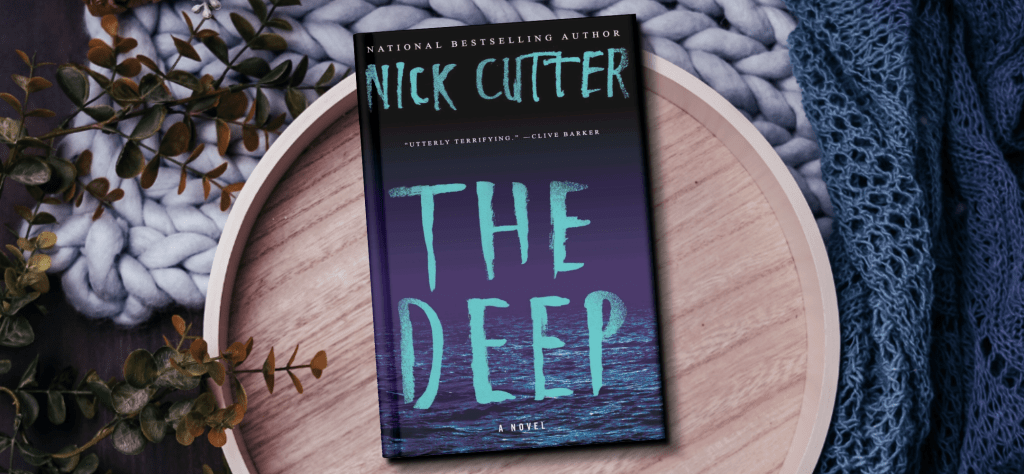
Title: The Deep
Author: Nick Cutter
Release Date: January 13th, 2015
Pages: 394
Genre: Horror, Sci-Fi
GoodReads Rating: 3.41 ★
DISCLAIMER: This article contains affiliate links. If you click any of the links and make a purchase, I earn a small commission at no extra cost to you. As an Amazon Associate, I earn from qualifying purchases. Thank you for the support!
This review is probably going to be the longest I’ve written because I have so much to say about where I believe The Deep went wrong. I was massively disappointed by this novel, and I’m baffled by so many of the choices the author chose to make. I actually own this book as a physical copy, and I don’t buy books very often, relying more on my library; somehow, having this book as a physical object makes me even more angry with how terrible it was. I literally threw the book across the couch the moment I finished it because I desperately wanted to get it away from me. My husband commented that it was the first time he’s ever seen me that upset with anything I’ve read, and I’ve never thrown a book before. This was also the selection for my book club for June, and I feel the need to sincerely apologize to every member of the club because they all hated it as much as I did. At least it’s generated some fun inside jokes, but The Deep literally tarnished my reputation for selecting books for the club.
When a pandemic dubbed the ‘Gets starts sweeping through the population, the world’s best scientists are scrambling and failing to find a cure. Worse, they’re forgetting that they’re looking for one. The illness causes people to forget; they forget their identities, their loved ones, and eventually they forget how to breathe.
In humanity’s darkest moment, a ray of hope appears in the most unlikely of places. Deep in the ocean, in the Mariana Trench, a substance is discovered. It’s dubbed Ambrosia, and by all appearances, it can heal beyond any modern medicine. It might be the only thing that can eradicate the ‘Gets before it eradicates humanity.
Lucas isn’t a scientist or an engineer; he’s a veterinarian. Typically, he would never be called down to the special research base built eight miles below the surface. However, Luke’s genius brother Clayton is on the base collecting Ambrosia, and he sent a very strange message to the surface, calling for Luke. Immediately after, the station went completely dark. Luke has to descend to the Trieste with a submarine pilot, Alice, to discover what’s really going on deep under the sea.
Characters
Luke is the main character, and the most I can really say about him is that he’s a boring, neutral, nice guy. I can appreciate some of his bravery because Luke does experience a lot of fear throughout the story, and he pushes on. I liked that he has the desire to help everyone on the ship, but most of the time he’s a bit of a blank slate. I also think that Luke doesn’t react with the appropriate level of emotionality in certain situations. At one point, another character gets their ear ripped off, and Luke just… bandages it up. No problem. I think I would be angry or crying or numb, but Luke is just tepidly afraid.
I’m also just not interested at all in Luke’s backstory involving his son. Zach went missing several years ago, and Luke spends so much time thinking about it. It was definitely traumatic, but he just thinks and thinks and thinks about it. I was so sick of being in his head. Zach was also too young when he disappeared to have any personality beyond “generic child,” so I didn’t feel attached to him.
Alice, or Al, is the officer sent to the depths with Luke. She’s a submarine pilot, so she’s able to somewhat naturally provide exposition about what’s going on in the deep sea. I liked Alice quite a lot! She’s tough, and she has a sense of humor that brings a bit of levity to the oppressive atmosphere at the bottom of the ocean. I also think that the way the station affects her feels more valid and less out of nowhere than Luke’s fears because her fears involve water and undersea craft. It’s much easier for me to believe that the station at the bottom of the ocean might flood than the idea that somehow a massive millipede snuck on board. Despite liking Al, I think that we didn’t get enough of her thoughts and inner world. We don’t really know why she was drawn to specific parts of the ship or why she ends up in the situation she did. I liked her and would’ve liked to have seen more.
LB is a Labrador Retriever! She’s so sweet and so adorable, but she does go through a lot of hardship. If you don’t like watching dogs be stressed or afraid, I don’t think you’d enjoy this book.
I think the only other character of note is Clayton, Luke’s brother. I don’t think he was really fully developed. Nearly all of his time on the page is spent showing his experiments where he brutally tortures animals in the name of scientific progress. He doesn’t like Luke, he feels nothing when Luke arrives, and he only ever speaks to him with contempt. He’s a one-note sociopath, but the narrative does try to make him more sympathetic in the end. It doesn’t work for me at all. I’ll get to it.
Writing & Atmosphere
I’m conflicted on the writing. On one hand, some of the descriptions in this book are so vivid and visceral that I couldn’t help but enjoy them. Cutter really succeeds when it comes to writing gross, gory situations, but there were so many writing quirks that annoyed me to death. For example, I really hated how noises were written out. Each and every sound would be described, and then written out in onomatopoeia.
“Al stood and moved toward the noise, her boots going tak on the steel grate. She took five steps, then ten. Tak. Tak. Tak. Tak.”
The Deep (2015)
“HUTHUMP!—this time so forceful that the metal grate shivered under their feet.”
“The children’s footsteps intensified: they danced a mad tarantella now. TRRRRRAACHIKKK!”
Imagine reading examples like these dozens of times. Not only is it repetitive through the combination of both styles, but it also made me feel like I was being read aloud to, like this was a children’s book. It’s a bit amateurish to repeatedly resort to trying to type out a sound instead of finding accurate language to describe what you’re trying to describe. I think that Cutter writes his books a bit like they’re movies where the audience is getting sound cues, but books aren’t movies. You can’t treat the mediums the same way.
I would be remiss not to include a quote that I would consider some good writing, considering the amount of negatives I’m including. I’ll be fair about it!
“The Trieste shivered. The walls seemed to expand like a pair of lungs inhaling a slow, contented breath. The station settled and there came, suddenly, a persistent silence—a creeping, secretive silence that carried down every tunnel.”
The Deep (2015)
That’s good. I like the metaphor of the station breathing. I like the tension of the silence, something that would usually be welcomed. I like this as a moment of calm after some intense horror! There are some good things about the writing.
I’d really hoped that the atmosphere would’ve been better. On paper, this should have been a slam dunk to create a scary atmosphere for me specifically because I am scared of the dark, I am scared of the bottom of the ocean, and I am claustrophobic. A dark, cold base at the bottom of the crushing sea with multiple areas that you have to crawl through because they’re so small? Yep, that’s a hat trick. Unfortunately, it just didn’t hit me like I suspected it would. I was too put off by the other issues with the writing and the plot to really sink into the atmosphere in any way.
Plot & Pacing
The pacing was so strange. I have literally no clue whether to call it fast or slow, but all I know is that it wasn’t well-paced. The chapters are mostly extremely short, only around two to three pages, so it’s very difficult to sink into the story and find a comfortable rhythm. The first couple of chapters are also heavy on the exposition. Some of it is great at building intrigue, like the information introducing the Ambrosia or the mystery surrounding Westlake, but some of it could have been cut. There is an entire chapter where the man giving Luke a ride to the rig explains how his wife died of the ‘Gets. It’s so slow and boring, and it comes out of nowhere and doesn’t lead to anything. Cut it.
When the characters actually get down to the Trieste, the base at the bottom of the sea, there isn’t a good sense of escalation. The atmosphere is immediately charged and dangerous, and both characters start experiencing hallucinations near immediately. Alice has a bit better of a build up to her story, but Luke right off the bat is imagining eyeless children and thinking he’s hearing millipedes in the base. But then, that strangeness stagnates. We stay at that same level of weird for over a hundred pages, and it gets really tired fast. I was so bored, I considered DNF-ing a book I own. I’ve literally never done that before in my life. So, the pacing? Terrible.
My first complaint about the plot of this book is that it has absolutely nothing to do with the ‘Gets, the pandemic mentioned on the back of the book. I really love books about plagues or epidemics; my favorite book of all time is Camus’ The Plague, so obviously the ‘Gets intrigued me. I’d also read a book with a very similar pandemic last year. The Night Parade features an outbreak of something the people call Wanderer’s Folly where suffers start to break down and become confused, eventually just wandering in circles. I was looking forward to a difference exploration her in The Deep, but the pandemic is highly irrelevant to the rest of the novel.
The origins are never explained; the surface isn’t really involved in the story at all. The characters never feel like they’re getting the ‘Gets, in fact it’s quite the opposite. In the Trieste, their memories seem stronger and more vivid than ever. This story would’ve been the exact same if it was simply about a billionaire who funded the mission to achieve immortality. I wouldn’t have questioned the finances, and I think most other readers wouldn’t. It’s far more frustrating to me that the pandemic literally means nothing at all to the plot than the finances of an underwater base.
The other main issue is that it’s not possible for the reader to actually understand the stakes here for so much of the book, easily until the 60-70% mark. For a hundred and fifty pages most of the horror is Luke imagining things that could be scary. He immediately starts comparing the sounds of the water pressure rippling over the metal hull to the sounds of children running, and then he thinks about how the pressure of the deep would pop these children’s eyes! How scary! Except that this… isn’t happening. It’s impossible for this to be happening. I’m not frightened because I know that this isn’t happening. It continues like this as Luke imagines a millipede in the darkness. I’m not scared because I KNOW that it’s impossible for a millipede to be in the ship. He’s just scaring himself.
It becomes clear much later on that something can physically manipulate the Trieste and what’s inside it. I think it was a mistake to leave this so late in the story. If I knew that a threat could manifest at any time, it would’ve greatly increased the tension, and it would’ve made Luke look less like an idiot.
The confusion and boredom continue through the numerous flashback chapters. Within the context of a first read-through, these chapters don’t make any sense. For example, in one flashback from when Luke was around eight years old, he recalls exploring a drainage pipe with his brother. In that pipe, there’s a long, creepy, greyish hand that is clearly inhuman. I was so incredibly confused about what was happening here. Was it an early symptom of the ‘Gets? Was it the memory being manipulated by fear and insanity? No to both. This is a real memory that Luke really has. How is this possible? There’s literally no way that I could’ve guessed, but the answer is that a cosmic entity has been controlling things and appearing in Luke’s life for many years without his knowledge. More on that later.
There are some good parts of the novel, but even the good parts end up being messy and unbelievable. At one point, Al and Luke get a notification that there’s something wrong with their oxygen, so they have to crawl through a super claustrophobic tube, inching forward on their bellies and pulling themselves through this pitch-black tunnel, to get to the oxygen room. I was frightened! Caving and cave-diving are my worst nightmares, and this hits all of those marks. Except… I kept thinking about the scenario for a few moments, and immediately I started questioning this setup. Why are the labs, sleeping quarters, and docking station all easily accessible, but to get to the room that manages all the oxygen in the base, you have to crawl on your stomach through a dark tube? If there’s an actual issue with the oxygen, wouldn’t you want to get to the room to do repairs as soon as possible? Why are we crawling through a tube when we’re passing out from hypoxia?
Everything about this book is like that. If you think about anything for even a fraction of a second, it doesn’t make sense.
The Mommy Issues
If I had a nickel for every time I’ve read a book this year written by a male author that included an extremely fat woman who is described like some kind of horror monster who is despised by her son and eventually killed by him, I would have two nickels, which isn’t a lot, but it’s weird that it’s happened twice.
There’s a problem with the way that Cutter chooses to describe Beth, Luke’s mother, throughout the book, and I find it quite difficult to pin down what exactly I’m trying to say here, so please forgive me if I ramble a bit or sound unclear. The way that Cutter writes about Beth is fatphobic. Beth is not a nice person. She’s very cruel, and early in Luke’s childhood she worked as a security guard for a troubled teen camp. Those are notoriously awful places, and the troubled teen industry has been linked to numerous cases of assault, sexual abuse, and death. Beth engaged in this industry willingly and happily. That was enough to tell me that she was a person who enjoyed tormenting those with less power than her. It told me that she was cruel and evil and despicable. However, one day on the job, Beth is attacked by one of the teens at the camp and has her knee shattered. It never ends up healing correctly, Beth goes on disability, and she starts to eat a massive amount of flavorless porridge, seemingly to cope.
She becomes morbidly obese. Excuse the long quote, but I felt it was important to include.
“But she kept shovelling that grey gruel and soon thickness gave way to bloated girth. Her arms projected from the sleeves of her shapeless shifts like the booms on a sailboat, larded with folds of quaking flesh that resembled hunks of wet wool. Her thighs widened to the point that when sitting, her legs appeared to be welded together: a vast blanket of quivering skin. When she limped from her spot on the chair, her thighs rubbed together with a raw whispery note. Her features receded into the shapeless bloat of her face. Her eyes stared out of that netted flesh like two raisins thumbed into poofing dough.”
The Deep (2015)
Cutter is describing her physical appearance in such a way so that the audience will be disgusted by Beth and, as a result of that disgust, frightened by her. But what he’s describing here is not a monster that people should be afraid of; it’s just a fat person. That is blatant fatphobia, in almost a literal sense. By utilizing this kind of language, the author embeds the idea in the reader’s mind that “fatness” is scary, not that the woman is scary. There were plenty of examples throughout the book of Beth being a cruel, sadistic, evil person without needing to resort to demonizing fat people. Did he think we wouldn’t be disgusted by her actions if she was an average-looking woman? I promise, I would understand that Beth was a bad person even if she was thin and hot.
Unfortunately, I think the motivation might be even worse than that. I’m going to spoil part of the ending here, though I really don’t think it matters to the overall story, and I believe it’s vital to understanding this critique. Near the end of the story, Luke is able to access Clayton’s mind and memories. The way how isn’t very important. In Clayton’s memories, when Clay was a young teenager, Luke sees an instance when their mother enters Clayton’s lab, disrobes, and begins to sexually assault him. Not only is this extremely grotesque and distasteful, it adds nothing to the story. It doesn’t change my opinions on Clayton, it doesn’t affect Luke’s actions or memories of his mother, and it isn’t brought up again. Obviously, that bothers me. However, what bothered me more was a niggling question that wouldn’t stop squirming around in the back of my mind.
Did the author make Clayton and Luke’s mother morbidly obese so the audience would know to be disgusted by the scene where she sexually assaults her own child? Like, if she were thin we might think this was hot?
I can’t say one way or another. I can’t read Nick Cutter’s mind or know his true intentions. I am concerned that the intention behind making her fat was specifically so the audience would know that she’s evil. It’s not even like her being fat contributed to the plot. There was never a moment where her body inhibited her actions. She didn’t die because of her weight. Nothing! There was zero plot-based reason to make this woman so fat and to fixate on it so much, so I’m forced to draw other conclusions.
The Weird Sex Stuff
I’m not sure where exactly to put this in the review, but there’s also a significant amount of, for lack of a better phrase, weird sex stuff happening in this book. There’s the previously mentioned incest and sexual assault between mother and child, but there’s also an additional instance of what I would call pseudo-incest. At one point, Clayton’s hand gets amputated, and again, the circumstances of how don’t really matter. The hand is somehow moving on its own, and it kind of tugs on Luke’s jeans at one point. Luke thinks back to his first sexual experience where the girl he was with tugged on his jeans as a way to provide stimulation until he… climaxed. I don’t know how to write about this analytically, sorry. But Luke also specifically points out that the way the severed hand is acting is sexual.
“This was slow and deliberate. Worst of all, there was something…sexual to the gesture, that finger flirting lovingly along his ankle.”
The Deep (2015)
It’s pretty easy to argue that this technically isn’t Clayton interacting with his brother sexually. It’s the forces of the deep controlling the hand, but isn’t it still kind of weird? It’s still odd to have your brother’s amputated hand imitate your first sexual experience.
There are some other minor things. There’s a Hole in the wall of a few of the labs, and if I’m remembering properly, Luke gets an erection the first time he sees one. Something about the deep also makes Luke and Al want to have sex with each other. It’s not that any of this is necessarily the worst thing, even. I’ll go into more in the next section, but the Deep, or whatever is in the Deep, is trying to mess with the characters psychologically, so turning their natural human instincts against them is a great way to do this. The emphasis on sex and sexuality just feels weird because there is no further manipulation of the baser instincts, like hunger or thirst, and there’s no thematic relevance that I can see about all this sexual tension.
The Ending
I typically try not to spoil the endings of books too much because I know that some people would still like to read this book despite, or maybe because of, my negative review. However, I need to talk about the ending of The Deep. It’s… so bad.
For some context, Luke’s son Zach had an episode when he was younger of believing that there was some kind of monster hiding in his closet, as many children do. Luke tries to tell him that these creatures are not real, only figments of his imagination. Zach misunderstands, believing the monsters to be called Fig Men. Luke does a little faux ritual to banish the Fig Men from Zach’s closet and allow him to sleep peacefully.
Here’s the thing: the Fig Men that were in Zach’s closet were real, somehow. The book calls them the Fig Men for the rest of the story which, I hate anyway because I think that’s an extremely unintimidating name. Let me try to explain how the Fig Men work, even though I don’t understand it myself at all. The Fig Men are ancient, evil beings who were placed at the bottom of the ocean by God so that they couldn’t prey on or harm humanity. However, somehow the Fig Men were able to affect the surface in certain ways. The Hand that Luke would see throughout his childhood was actually somehow the Fig Men reaching out to… scare him, maybe? I’m not sure why they were doing that.
When Zach went missing, that was actually because the Fig Men opened up a Hole in the park that day and kidnapped Zach. They did this because they knew that Clayton was intelligent enough to get to the bottom of the ocean and start doing science down there, but they can’t manipulate Clayton into bringing them up top because Clay is a sociopath who doesn’t care about anyone or anything. So, they needed someone as smart as Clay with someone as easy to manipulate as Luke in order to enact their plan.
Now, the humans are only at the bottom of the ocean because of the ‘Gets, remember? It would be easy to forget at this point because it’s literally never mentioned. So, did the Fig Men create the ‘Gets? They claim that they didn’t. Something like that is beyond their power. However, they did create the Ambrosia to tempt humanity down to the bottom of the sea. I have a couple of questions here. How did they know that humans would be coming down within Luke’s lifetime? They said they knew it would happen eventually because humans have a lot of hubris, but eventually for an immortal being could be a very long time away. It’s kind of implied that they exist in the present and the future at the same time, I think, based off of the Trieste in this scene being rusted, Clayton being old, and LB being white and toothless. The second question is, how the hell are the ‘Gets outside of their purview, but they can make a goop that cures every injury and illness and makes an organism functionally immortal? Doesn’t that seem much harder than creating a virus? I don’t get it.
Luke asks why the Fig Men are doing this, and I was wondering as well what their motivation could possibly be. The answer? The Fig Men just like to mess with people. This is the real, canonical answer.
“‘We like to toy,’ they said in perfect unity. Toy. Never in Luke’s life had the word sounded so monolithically sinister… Luke envisioned these ageless tinkerers examining bodies and minds for the sheer sport of it. Flaying brains open and plucking each synapse like the strings of a lute, teasing out every private fear and horror. Caring nothing for those they entrapped and tortured, committed solely to their games.”
The Deep (2015)
I don’t hate sadism as the answer in most circumstances. Hell, I could even argue that there’s something interesting to the similarity between Clayton and the Fig Men, but I would say that is reduced by this interaction not involving Clay. In this story, though, it’s super frustrating that the answer to everything is, “Eh, we were just fucking around a bit. We did it for the meme.” Any time anything doesn’t make sense it’s because there was no reason. The violence was all literally senseless. That’s frustrating!
The Fig Men tell Luke that he can go home, as long as he accepts their terms, and with that they will give him a gift. Luke has to take the Fig Men to the surface, and in exchange they will give him back his son whom they have had in the other dimension for many years at this point. Luke agrees, likely due to the guilt of losing his son. He agrees to sacrifice himself. I understand that he does this because he is insane now, but the thing that his son has become is not his child. It’s visibly not. His son is dead, and agreeing to the terms of the Fig Men will only bring more ruin to the surface, but whatever. He agrees. The freaky demon baby crawls inside his head, and they leave the depths together.
Recommendation
I think it’s fairly obvious at this point that I absolutely and unequivocally do not recommend this book. It’s incomprehensible to the point of melting the brain, it was completely unengaging, and it doesn’t deliver on the promises made by the back cover blurb in the slightest. I am utterly baffled by the existence of this novel. I’m going to need to literally recover after reading The Deep.
Trigger warnings:
Animal death, animal cruelty, body horror, child abuse, sexual assault, incest, pedophilia, gore, mental health episodes, blood, fatphobia, hallucinations, suicide.
Does the Dog Die?
Little Fly, one of the dogs, is dead and mangled. The other dog LB, Little Bee, dies horribly because, of course, she does. I hate this book. The scene where LB dies is horrific in a way that was really unnecessary. It made me actually, literally cry, which I basically never do. It felt bad and mean-spirited. It didn’t make me feel for the character or feel horrified at the book. It made me angry at the author himself. A mouse and a guinea pig are also killed.




 A Literary Apothecary