

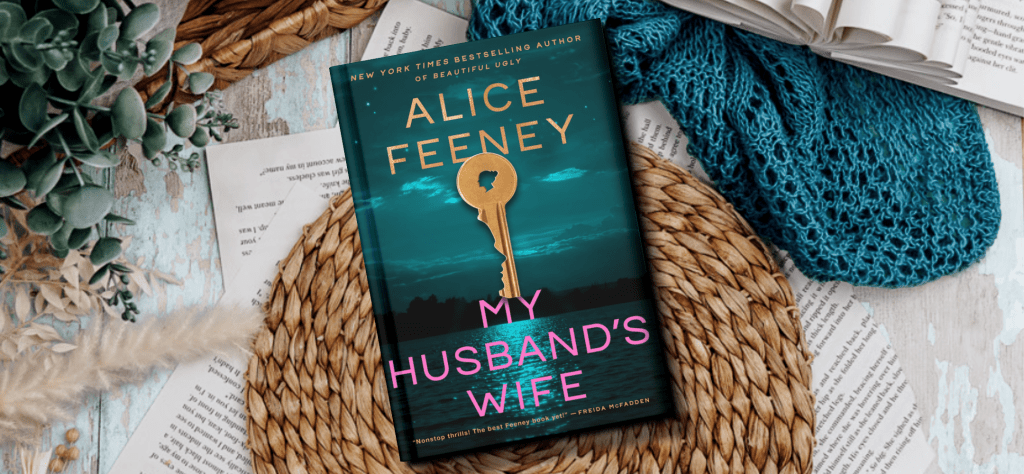
Title: My Husband’s Wife
Author: Alice Feeney
Release Date: January 20th, 2026
Pages: 310
Genre: Thriller
GoodReads Rating: 3.99 ★
DISCLAIMER: This article contains affiliate links. If you click any of the links and make a purchase, I earn a small commission at no extra cost to you. As an Amazon Associate, I earn from qualifying purchases. Thank you for the support!
I truly wasn’t sure if Alice Feeney’s books were for me. I read Daisy Darker a couple of years ago, and while I was interested in the premise and the atmosphere, the twist at the end enraged me nearly beyond words. Even two years later, I still can’t get over it. However, I tend to try to give authors a couple of chances before they make my “no” list, and Feeney is an incredibly popular thriller writer. Maybe I just got a bad egg. The opportunity arose to try again with this author when one of my book clubs was reading Feeney’s newest release, My Husband’s Wife. I tried to keep my expectations tempered, and yet, I still somehow ended up disappointed.
Eden Fox lives a quiet life with her husband in the seaside town of Hope Falls. Eden and Harrison recently moved away from the stress and turmoil of their life in London into a gorgeous old home, dubbed Spyglass. She paints, she renovates their home, and she runs. When she returns home from a run before her first art exhibition, and first introduction to the townspeople, Eden discovers that her key doesn’t fit in the lock. When she knocks, a woman who looks eerily similar to her, wearing her rings and her clothes, answers. Eden demands that Harrison tell this stranger to leave their home, but he claims that this woman, the other Eden, is his wife.
Six months earlier, Birdy, a London detective, is diagnosed with an aggressive form of cancer. Around the same time, she inherits Spyglass from a grandmother she doesn’t remember. Curious about the estate and her past, Birdy travels to Hope Falls. What she finds there is an invitation from a mysterious company that claims to be able to predict the exact date of one’s death. Knowing exactly how long she has left motivates Birdy to return to Hope Falls to exact revenge on someone who very much deserves it.
Characters
There are quite a few characters that have chapters written from their point-of-view; however, this instance doesn’t feel as overwhelming as some other books because of the way these POVs are distributed. Eden holds the majority of the story in the first part, but she disappears from the story after that. Gabriella, similarly, only appears as a POV for a few chapters near the end. This leaves the book with three primary characters: Carter, Birdy, and Harrison. While this is a drastically reduced list, I think it might have been able to be cut even further, as Harrison’s POV isn’t the most necessary to the overall story. He accomplishes very little.
Eden is a character who is not likable from the very beginning of the story, and I don’t think she’s meant to be. In her internal monologue, she comes across as quite antisocial and snobby. For the entire time that she and Harrison have been at Spyglass, she has made no effort to get to know anyone from the town, despite wanting to hold an exhibition. She’s never even met the gallery owner in person. It provides an image of Eden that makes her seem very entitled, and I think that works well for her character. While I understand that the isolation is necessary to make the basic conceit of the story work, I do think that it limits the number of suspects that the reader can latch onto. If Eden doesn’t know anyone in town, why would any of them kill her? Well that might be because of the actions of “Not Eden.”
Not Eden does have a name, but I won’t spoil it here. She’s the woman who takes over Eden’s life during her run, and as such holds a lot of mystery. The main problem with Not Eden is that she’s a plot black hole. Everything the reader is told about her backstory and motivations becomes a plot hole later. There is no way that she wouldn’t have been recognized by people in town given how active her job would have made her in the community. People recognized her car, but for years and years before Eden, Not Eden lived in the town. There is no reason that all these people should believe that she is Eden Fox.
Harrison is such a nothing character. His POVs didn’t tell the reader very much about the mystery, and his internal monologue is such an awful red herring. He is very often thinking things that make zero sense considering what he knows and his part in the mystery. It would be like if Harrison was constantly thinking, “The sky is red,” and then the twist they tried to pull was that Harrison knew the sky was blue the whole time. Why were you thinking that in your head to yourself where no one was watching? Unfortunately, Harrison is also attached to the whole Thanatos plot line, which I’ll get into later. It doesn’t make the story any better, though, and I still don’t think Harrison is very well written. He exists to be suspicious. That’s it.
Birdy is a quirky investigator along the lines of Sherlock Holmes or Cordelia Cupp from The Residence. That’s a great show, by the way. She’s witty and observant, but a bit socially awkward. She eats burgers wrong, goes everywhere on a moped, and dresses in little tweed coats. It’s cute. She’s also dying of a terminal illness, so she goes through bouts of pain and depression regarding the upcoming end of her life. Out of all the characters, I liked Birdy the most. Even though she’s arrogant, she has the ability to back it up. I do wish she had more of a history with Hope Falls. She lived there until she was ten years old, but it never feels like it. Birdy isn’t remembered by anyone, and she doesn’t have any base knowledge of the town beyond why Hope Falls is called that. It makes her feel like too much of an outsider.
Carter is a character I really didn’t like. He’s such a stereotypical cop, and I mean that in all the worst ways. He’s not very smart or observant, and while that’s part of his character arc, it doesn’t make him any more likable. He’s also very entitled. He believes that he should automatically get an open position for detective in his town, despite the fact that he’s never done an official investigation before. I don’t think he has any relevant training. Carter just thinks he deserves it because he’s the only guy who applied.
He’s also weirdly ableist. I don’t know if this was an intentional character choice or just insensitivity by the author, but there’s more than one instance of him being very odd about mental illness and disability. In this scene, Carter is running to catch Birdy’s dog, Sunday.
“I run toward the water, shouting his [Sunday’s] name over and over, like someone with days-of-the-week Tourette’s.”
My Husband’s Wife (2026)
Yikes. I’m assuming that was supposed to be a joke, but there’s a lot of other ways that this same idea could be portrayed humorously, like describing himself as a broken toy repeating the same catchphrase or a paper boy advertising the week’s biggest story. I don’t know; I’m just spitballing. If that’s not enough ableism for you, he describes Harrison’s mentally disabled daughter to Harrison thusly:
“‘And you’re a gold-plated arsehole,’ Carter says. ‘If you won’t tell us the truth about your wife, maybe we should arrest your freak of a daughter and question her again instead?’”
My Husband’s Wife (2026)
Can I type “yikes” again? Because this feels like another yikes. Carter calls an eighteen-year-old who was in a terrible accident that left her disabled and traumatized a freak, simply to hurt her father’s feelings. When the intention is the same, you might as well go all the way and use the r-slur. Really get in there and show those… show those disabled people who’s the boss, I guess. That’s what this feels like.
So, yeah. I don’t like Carter, even though every woman in the story is weirdly thirsty for him. I’m still on team ACAB.
Writing & Atmosphere
The writing was… interesting. Can something be both basic and overwritten at the same time? I don’t remember any moments of particularly flowing prose or vivid description. When there is deeper effort in the writing, it’s generally following a character’s internal thoughts. This is where the writing feels like it goes a bit off the rails and into the realm of purple prose. For example, this is a segment of Eden’s inner thoughts early into the story:
“Everyone lies and everyone dies. Those are the only two things you can be sure of in this uncertain world. Twilight is my happy place. That thin line of time that separates night from day, and day from night. Twilight. Sunset. Nightfall. When we give things different names, it’s easier to pretend they’re not the same. Like love and heartbreak. No joy lasts forever. No sorrow lasts forever, and time is too precious to waste.”
My Husband’s Wife (2026)
I don’t necessarily believe that it’s terrible writing in a vacuum. I’ve read literary fiction that is far more overblown with its prose than this, but I think the issue here is a lack of consistency in this writing style. The literary books are literary all the time, but My Husband’s Wife fluctuates between this and a much more practical, simplistic writing style that doesn’t feel the need to engage with more abstract language.
“Carter is alone and sitting behind a desk that looks too big for him. He is listening to what looks like an old Walkman with his feet up on the desk. I notice how neat and tidy it is, just like the man himself. His uniform is pristine and his hair looks as though he just combed it.”
My Husband’s Wife (2026)
This is deeply mundane writing. It functions fine, and while writing like this does tend to work better from a pacing perspective for a thriller than long, flowery, meandering prose, the juxtaposition feels jarring. Despite some of these more winding descriptions, the book never manages to build an atmosphere. This seaside town is a great place to build a windy, misty atmosphere, and the town even has a spooky Day of the Dead festival that should’ve built some tension, but I was never able to imagine it as anything other than blandly sunny and sterile, like a boring postcard.
A book that did a much better job at enriching the environment of a small, mostly empty coastal town was The Wolf Tree by Laura McCluskey. I would recommend checking that out if you’re interested in coastal murder mysteries.
Plot & Pacing
The simpler sentences and focus on characters kept the pace moving quickly. I would say that this was a very easy read. The beginning of the story has a great hook, and Feeney managed to build enough mysteries into the plot to keep me engaged with the story throughout.
The plot is another story. It’s straight-up a plot hole palooza in this book. My first major complaint is Thanatos. Within the story, Thanatos is a company that uses user data, from genetics to lifestyle habits, to predict the exact date that someone is going to die. Birdy uses this service after discovering that she has multiple tumors, and she receives a date that she is going to die. Thanatos has close to nothing to do with the actual story. This is a cool concept upon first glance, but there is no way a business like this would work without some supernatural intervention. So, I immediately thought there was some supernatural intervention. Remember, the only other Feeney book I’ve read was Daisy Darker, and if you’ve read that book, you know where I’m coming from.
This is not the case. Thanatos is supposed to use science to predict your death date. What about murders? What about car accidents? What about outbreaks of Cyclospora… uh-oh. At least a quarter of a million people die every year from “non-natural” causes. This company is utterly ridiculous. Turns out the book knows that, and it doesn’t factor into the plot aside from one instance that easily could’ve been rewritten. Thanatos could have been removed from the story entirely, and it wouldn’t have affected anything. Birdy’s actions are motivated by her impending death, but the doctor already said she was going to die “soon.” Does having an exact date really matter that much?
I think what makes Feeney’s work so frustrating to me is that she is very good at posing tantalizing questions to her readers. Who is the woman claiming to be Eden? Whose body was pulled out of the water beneath Hope Falls? Why does Carter know where everything is in the Fox household? The problem arises when the answers to these questions have to be revealed. Carter? He shouldn’t know where everything is in the household. There was legitimately no explanation for this. The person pretending to be Eden should have been recognized by the townspeople because she had to have been going into town under a different name for years. There’s no way this scam works with “Not Eden” as the replacement unless the entire town is pretending along with them.
Some of the clues and red herrings are also more interesting than the actual explanations. For example, Carter transcribes interviews that he does from an audio format to a typed document for Birdy because that’s how she prefers to handle interviews. However, there’s an idea introduced that Carter might be altering the transcripts to hide something from Birdy! That’s an exciting twist, seriously! It places a ton of suspicion on Carter, and it makes the reader question everything we believed from the interviews thus far. What does this lead to? Nothing! Red herrings like this happen dozens of times, and after a while, it becomes difficult to get invested.
Typically, in a mystery, each of these elements is either explained away or leads to a different clue. Maybe the bad transcripts lead Birdy to the house of the Black Widow gallery owner who has dirt on Old Stu, who guides her back to Maddie at the pub, etc. In My Husband’s Wife, threads are introduced, but it’s less like an intricate web and more like cut spaghetti. Most threads stop before they go anywhere at all.
The Ending
I do think the ending of this book is worth talking about in some amount of detail, but I’ll try not to spoil too much, just in case this book does end up sounding intriguing.
The ultimate twist of who the killer winds up being was extremely unsatisfying for me. The audience doesn’t really get to know this character on a level deeper than the surface, so in many ways the reveal felt out of nowhere. While there were some seeds planted to support the motivation for the killer, that doesn’t necessarily mean that the act itself felt justified to the audience. Initially, I had a bit of a problem with the way Eden’s death is portrayed as well. The killer mentions that Eden tries to talk her way out of being killed, claiming that they have the wrong person. However, when we saw Eden’s death from her point of view, it didn’t seem like she had a conversation with anyone. The way it reads, it almost sounds like Eden didn’t know the identity of her killer when she died, but that’s not accurate.
“I’m about to leave when I hear someone on the path behind me. Soon after that I am falling through a waterfall. My body twists and turns and spins until it smashes onto the rocks at the bottom of the cliff. The pain is intense but lasts less than a second. If anyone says She didn’t feel a thing they’re wrong. I felt everything I have ever felt when I was dying. The last thought I have before I die surprises me: True love kills.“
My Husband’s Wife (2026)
Sorry for the long quote, but I didn’t want to remove anything to provide the full context. While the seed of the killer is planted with the thought “True love kills,” in the moment it doesn’t direct toward anyone in particular, and with the context of the rest of the story, it could be aimed at anyone. Harrison for having an affair? Maddie for loving her brother? Gabriella for loving her father? It truly is such a broad thought that it’s next to meaningless as a clue. That’s fine, except it’s really only one of two clues we have about the identity of the killer.
That being said, the elements of the mystery that happened in the past involving Gabriella are actually presented quite well. The twists in that story relied on the reader having a keen eye and asking the right questions, and if they did so, they could absolutely solve that mystery. I don’t even want to reveal more detail than that because I believe that this mystery was the most rewarding one of the book. The reveals are paced well, the character motivations make sense to me, and while I wouldn’t describe the twists as brilliant, I would say they were quite enjoyable.
My only other real complaint about the ending involved Gabriella. The book has a couple of chapters from her point of view, and while it’s helpful to glean some information about the mystery, Gabriella’s internal motivations make zero sense to me, and her chapter as whole feels like it was part of an earlier draft. Gabriella is very close with her father, Harrison, and desperately wants to live with him in Spyglass. She’s also very close with her aide at the hospital, Mary, who helped her to open up and learn to speak again. However, in her internal POV, she seems to hate Mary and want her out of the way to be closer to Harrison. Why? She and Mary had a very close relationship, and this doesn’t go anywhere within the plot. Gabriella also mentions being happy that Birdy is going to die soon, and while I find this a bit more believable, it doesn’t mesh well with the relationship we see between the two characters following this chapter.
Gabriella is also described in this chapter as escaping from her father’s car and running off into the night, and this didn’t lead to much either. I’m not sure if readers were supposed to believe that Gabriella was the mysterious skeleton woman who approached Birdy in the library, but that seemed excessively unlikely considering Gabriella’s mental capacity. Her escape is never brought up again in the climax. She doesn’t cause an issue or distract a killer. Harrison doesn’t run into the house trying to find her and see blood in the library. It just leads to nothing, and I found that very strange.
The ending really was such a mess.
Recommendation
The thing about My Husband’s Wife is that I don’t think it’s bad enough to earn any amount of rage from me. I can’t say that it was too morally objectionable, the writing was fine, and in the moment I was enjoying myself. Is that enough for you as a reader? It is for me, sometimes. If so, it might be a fun little read while turning your brain off lounging at the pool this summer. However, if you think about any of the details beyond what the author is telling you in the moment, I think you’ll end up in the same boat as me: unsatisfied and a little frustrated that the mystery ended up falling to pieces like a house of cards.
Does the Dog Die?
There’s a husky named Sunday in the book. He doesn’t die, and he doesn’t even experience any distress. He’s a happy, healthy dog.
Trigger warnings:
Infidelity, murder, attempted murder, suicide, suicidal thoughts, cancer, ableism, car accident, alcohol, death of a parent.

 A Literary Apothecary