

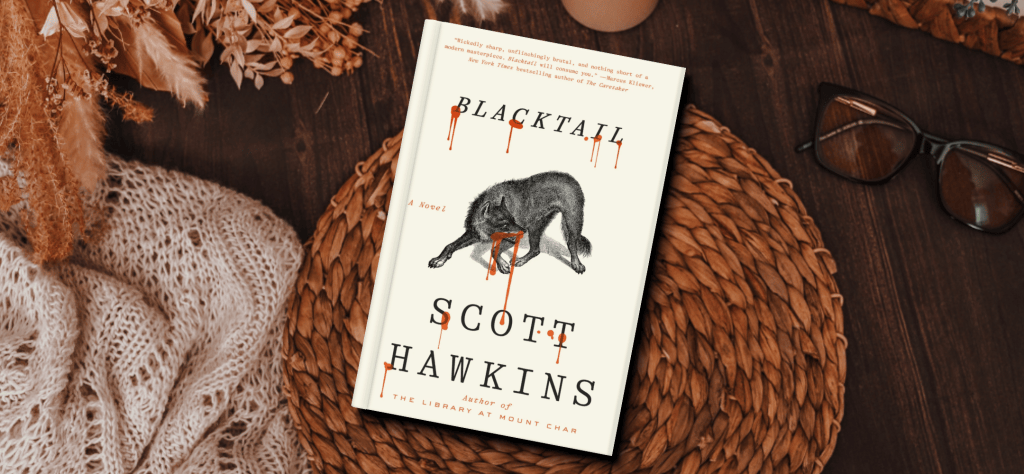
Title: Blacktail
Author: Scott Hawkins
Release Date: September 1st, 2026
Pages: 288
Genre: Fantasy Horror
GoodReads Rating: 4.12★
DISCLAIMER: This article contains affiliate links. If you click any of the links and make a purchase, I earn a small commission at no extra cost to you. As an Amazon Associate, I earn from qualifying purchases. Thank you for the support!
Thank you to NetGalley and Zando for this Advance Reader Copy!
This review has taken me longer to write than any other that came before it. I’ve struggled so much with how I could possibly even describe Blacktail, let alone my feelings and criticisms of it. I liked The Library at Mount Char quite a bit, so when I saw that Scott Hawkins was finally coming out with a sophomore novel, I was excited. I applied to receive the ARC on a whim, not believing I would ever receive it. His first book has over four hundred thousand ratings, and I’m not a very well-known reviewer. I was ecstatic when I received the email informing me I had been given a copy.
I cannot describe how disappointed I was in this experience. Scott Hawkins is not afraid to alienate a reader. He will write events that are inexplicable, strange, and off-putting. This aspect of his writing persists in Blacktail, but in a much more confusing, disgusting, and difficult-to-accept way. Everything from the line-by-line writing to the characters to the world-building is significantly worse, and despite the amount of sex and violence, more immature. It’s a crazy comparison, but I legitimately felt like I was reading the Warrior Cats series by Erin Hunter, just with more dog sex.
I would also like to note: I typically avoid spoilers as much as possible for books that I receive as ARCs. However, there are certain plot points in Blacktail that I need to discuss in detail to properly convey my points. I’ve held off on publishing this review until after Blacktail was released so that I could discuss spoilers and not ruin the experience for other, excited readers. Just be aware that some plot points will be spoilers for the book, some of them significant.
A young wolf named Blacktail is the last of his kind in the forest he calls home. Encroachment from the world of men shrinks his territory every year, and these men bring weapons that no wolf can counter. The wolf follows a scent down from the mountain and into the territory of men, meeting a house dog named Renren. He offers to take her away from her world and into his, but before he can, Renren is killed by humans. Blacktail fills with a rage he has never felt before and swears vengeance on all humankind, starting with Renren’s owners.
His fury calls out to an ancient feline witch, The Great Kitty Mother, who believes Blacktail might finally fulfill a long-held desire for the animals of The Hunt. She offers him the opportunity to kill the human race if he can find and wake the ancient Forest God. Blacktail’s bloodlust is not sated, so he agrees. His journey takes him across hundreds of miles and encounters with strangers who all seek the same goal: the end of the human race and the rise of the Forest God.
Characters
There are a LOT of characters in Blacktail, but they aren’t overwhelming. Each set of characters is typically featured for only a single chapter as they meet and influence Blacktail, and then they disappear from the story. They function less as fully fleshed-out-characters, and more as lenses through which the audience can view Blacktail and representations of philosophies that he must grapple with on his journey. I did like the personification of the animals. Lower, prey animals refer to hunters as Lord, and Blacktail is considered the Lord of his forest as the apex predator on the mountain. Mates consider themselves “married.” I especially liked some of the characterization of marking behavior. Wolves mark using poetry and lyricism. That, to me, suits an animal that howls like wolves do.
Blacktail himself is a character that I feel conflicted about. I found him likable at first. He’s young, and he’s unsure about his belief in the Forest God. He’s certainly not devoted to him, even once he begins his journey to wake the god. Many of the characters that he runs across are devout, and Blacktail does begin to adopt these beliefs. However, halfway through the novel, there’s a very jarring pivot in Blacktail’s beliefs and he becomes a deeply entrenched, dogmatic despot for The Forest God and The Hunt. At this point in the story, the point of view also shifts from being mostly internal to Blacktail to more outward. We don’t get to read as much about what Blacktail is thinking; instead we read about what others think of Blacktail. It makes him feel much more one-dimensional, and it makes his harsh turn into religiosity feel undermotivated.
Blacktail’s actions are also confusing in their morality. I don’t know what kind of character he’s supposed to be, but Blacktail regularly abuses his power to rain violence down upon others. He regularly demeans and dismisses those around him, including other wolves. He kills innocents over and over, and the narrative never really interrogates it. It’s incredibly easy to hate Blacktail by the end of the story, and I’m not sure if the audience is supposed to hate him.
Writing & Atmosphere
There is a significant problem that marred the reading experience for me and was incredibly distracting. The number of times urine or urinating is mentioned is truly unacceptable. Every few pages someone pisses, typically out of fear. It happens across humans and animals. It generally doesn’t have very much to do with marking one’s territory. After a while, it felt like Hawkins couldn’t think of any other way to express fear except by someone pissing. I actually counted how many mentions of piss there were because it was starting to become genuinely shocking. There are sixteen mentions of “piss,” three mentions of “urine,” four mentions of “wetting oneself,” and 4 mentions of “pee.” That’s twenty-seven mentions of urine in some way or another. That’s one mention every ten pages! I’m sure I’ve missed some as well.
Some quotes:
“I probably smell like I’ve pissed myself, Fang thought with a twinge of embarrassment.”
“Blacktail growled. At the sound of it several of the pack wet themselves. The air filled with the hot smell of fresh urine.”
“When that was done he scattered the pieces throughout house, pissing and shitting as he went, ruining things.”
It’s also semi-often combined with other words: fear-piss, terror-piss, death-piss, etc. I cannot explain how grating this became. Is it supposed to be funny? Am I missing the joke? I understand that they’re animals, but a lot of mentions of piss come from humans pissing themselves in terror at seeing Blacktail. While he is a large wolf, I’m pretty sure if I saw one I could avoid pissing myself in fear. I live in Florida. I’ve probably seen a hundred alligators in my life, some as large as eight feet long, and I’ve never once pissed my pants.
The other thing that was fairly uncomfortable to read about was the amount of dog horniness contained in these pages. The actual sex itself isn’t necessarily described in graphic detail, but the insinuation is still more than I would prefer. I feel like I can’t describe it any better than the quotes themselves.
“He had known no other way of life. But his erection cranked up another notch.”
“She was a handsome beast, and the heat was on her so fierce that she thought she might go mad…. Little One’s prick rose up at her scent.”
“They mated once, then again. The pleasure of it was beyond anything she had ever known.”
It’s natural. Sex is natural. Mating is natural. Sex as a motivation is natural. However, I can hold all of those opinions and still be uncomfortable reading about how pleasurable sex was for an animal. While placing oneself into the mind of the character is an important part of the writing process, I think it’s also important to consider whether or not what is being written is necessary to the story. In other instances, the author simply describes this mating as “becoming husband and wife,” and that’s enough for me to understand what’s going on.
There are some passages of prose that I enjoyed, and overall the writing maintains a level of gravitas that makes the story feel like a fable or myth. That works quite well with the way the story is framed. The dialogue between characters is more noble than everyday vernacular. All of that contributes to making the world of the animals feel much different and antiquated compared to the modernity of the humans in the novel.
“As the ages stretch out and men killed the hunt in the world, it seemed to me that they also killed it in the souls of beasts. I had almost— No. Not almost. I had given up hope. Then came Blacktail, and we were delivered.”
Blacktail (2026)
Plot & Pacing
The pacing of the story is a bit odd. This is structured less like a traditional novel and more like The Odyssey, with several vignettes following a central character through an overarching journey. That’s not necessarily a bad thing. Some of the vignettes are more enjoyable than others, but they do contribute to the overall plot and development of Blacktail as a character. It does mean that the book is very segmented, and Blacktail can occasionally feel like a very different character between chapters. Most of them are from Blacktail’s perspective, but as he becomes more… supernatural, the narrative moves away from his internal world and more toward the creatures that are reacting to him.
Typically, this would be one of the longer sections of my review, but in this instance the vast majority of my critiques involving the plot are within the “themes” section. This is partially to separate out my “spoilers” into one large section, but it’s mostly because my issues with the plot are not the actual events themselves. I found the plot overall to be entertaining, and I was curious enough to find out what happened next. However, the meaning of the plot points is entirely obfuscated. I’ll get to it.
The one thing I suppose I will lightly spoil in this section has to do with Blacktail’s parentage. Blacktail is part wolf, part something else. Throughout the story, characters are always thinking that he smells a bit strange, and at one point another wolf has a “vision” of the night Blacktail was conceived and he can’t comprehend what Blacktail’s father is. Or… was it a vision at all? It’s described as possibly being a dream. Due to the events that happen and the powers that Blacktail is able to harness, I believed that his father was going to be an important figure: The Forest God or even Satan. If you’re interested in this plot point, I would recommend not getting your hopes up for a specific answer.
Oh, this book also IS connected to The Library at Mount Char. In the last 5% of the book, the Tiger God Nobunaga is mentioned. It’s not a strong connection, but it’s fun to imagine these two insane universes existing at the same time somehow.
World-Building
The world-building of Blacktail is one of the highlights. The Library at Mount Char had so many fantastic concepts, and this book is no different. This author is entirely unafraid of his own ideas, and it makes the world entirely unique. Even small mentions of insignificant world-building, like the fact that squirrels in this world are prone to joining death cults to try to appease Car, are very fun.
The way that the animals try to comprehend cars, or Car as they call it, feels very in line with what you would expect from animals. They believe it to be a living thing independent of humans, like a human’s pet. It’s personified as having breath and growling. The animals also view it as a sadistic predator because even though it murders and maims animals, it never eats them. These small details add to the perspective of the animals and make it easier to sink into their world.
I did also enjoy many of the more supernatural elements, to a point. Cats in this world are essentially witches, able to weave spells, literally. All cats are of a coven who serve one known as The Great Kitty Mother. Their magic is literally able to affect the world. Heaven exists, Hell exists, angels exist. There are also gods beyond those of The Forest and Reason, like the God of Lost Things. The pantheon makes the world feel much more expansive. Again, this book has never met an idea that it turned away. That’s all quite fun, and this level of absurdity is totally acceptable and expected to me. The absurdity that I couldn’t abide lay with the themes.
Themes
I feel like the first plot point I need to mention in terms of theme is everything involving the death of Renren. This is where the review is going to get more spoiler-heavy, so be warned. Renren is the female dog that Blacktail mates with. He physically mates with her, and when she falls pregnant, he offers to take her away from her home and into the woods with him to start a wolf pack. Renren agrees to this, but before she’s able to leave with him, she dies.
Renren’s human owners are… not exactly morally grey, but they aren’t pure evil, in my opinion. Renren is left outside all day without any shelter, which is obviously animal abuse, and that level of disregard for her makes Blacktail’s crusade against them much easier to swallow for an audience that is obviously made up of humans. However, Renren’s death is not tied to any human action that is evil. Her owners take her to the vet to be sterilized, spayed, and as is the case with many dogs, the vet aborted her and Blacktail’s puppies to perform the procedure. This is not uncommon. There was an issue with the surgery, and Renren dies from internal bleeding. This complicates her death in several ways.
I’m not accusing the author of any specific political leanings, but there is a certain reading of this story that is anti-abortion. The dog fetuses are always referred to as Blacktail’s children or his puppies. They’re described as being murdered by humans. These are the talking points and language that anti-abortion activists use to try to make pregnant people seeking abortions feel guilty and to enact legislation banning abortion access. It’s uncomfortable.
Sterilization is also repeatedly framed as a crime against animals and against nature. I keep thinking about a specific instance much later in the book where Blacktail meets a chihuahua who has been neutered.
“Not that his bloodline mattered—Nugget’s genitals had been cut from him when he was still a puppy, the scar now white and faded beneath a fine mist of fur… When Blacktail drew back out of [his soul], Nugget’s mind was clear for the first time in his life. A moment later he opened his eyes and looked down at his genitals, which were now whole and healthy.”
Blacktail (2026)
This quote is objectionable on quite a few levels. If the chihuahua, Nugget, was so genetically weak and distorted from the creature he used to be, why does Blacktail want those genetics to carry on into the new world he’s building? Also, it’s deeply strange, which is not a criticism that is valid on any level except personal, yet it’s a criticism I make nonetheless. It’s also just so odd how much emphasis the book places on the sadness and wrongness of spaying or neutering pets. It’s a good thing to spay and neuter dogs. It’s healthy for them and better for the dog population as a whole, so the book taking such a strong stance against pet sterilization is objectively wrong.
I understand that this is being told from the perspective of an animal, and to an animal, sterilization would be wrong and unnatural, but the audience is human. What value is this argument to us? What are we supposed to take away from Blacktail’s morals? Here’s where I question my interpretation. Not every book is trying to make its protagonist correct. Not every book is presenting the audience with a moral. However, the philosophy, politics, or whatever you want to call it, is the central core of the novel. Every event is about building Blacktail’s philosophy or world-view or religion. Without it, the book is nothing. So, I am forced to attempt to interpret what the book is trying to tell me.
There are two factions that are warring within these pages: The Hunt and Reason. The Forest God is of The Hunt and believes that all creatures should follow the laws of the natural world. The Christian God is of Reason, which has allowed humanity to think and create tools that subvert The Hunt, like weapons, traps, cars, etc. Blacktail’s journey to embrace The Hunt and wake the Forest God is the core of the story, and as I’ve said, each vignette provides a deeper exploration of the principles of The Hunt.
My problem with this entire concept is that The Hunt makes no sense. Firstly, creatures that hunt use Reason very often. They position themselves downwind from prey, they consider the repercussions of what a fight might mean, they attack strategically; all of this is Reason. But humanity, without Reason, falls into a very particular spot in the hierarchy of The Hunt. We don’t have sharp teeth or claws. We specifically evolved Reason to build our arsenal of tools. The logic of The Hunt doesn’t allow for that. How would a rabbit ever rise up against a wolf? It’s impossible. So, within the philosophy of the Forest God, some creatures are just better and more powerful than others, and the ones who don’t have power should simply submit to those who do. Attempting to counter oppression goes against the natural order and must be punished with near eradication.
My other problem lies with Blacktail’s interpretation of which creatures are of The Hunt and which aren’t. Blacktail hates guns. This is extremely understandable considering his family was killed with one, and they do provide humans with a drastically “unfair” advantage against wildlife. What about a character like The Hider? The Hider is a serial killer who does use his teeth to attack, kill, and eat other humans, but he also regularly uses a knife. Is this not a tool of Reason? Yet, Blacktail never hesitates to call the Hider a man of The Hunt. The Hider is even rewarded for his actions—hunting, killing, and eating his own kind, which is taboo even among wolves—by officially being granted a place in the Forest God’s domain. He is turned into a coyote.
So the Hider is of the Hunt, despite his use of tools like knives. What about the hikers that Blacktail teaches Chester, a stray wolfdog, to kill? This is another couple of humans, and though they do not speak the language of animals like the Hider does, they still fight in a way I would expect Blacktail to respect. One of them even lands what would be considered a mortal wound on Chester with a branch. Yet, Blacktail never thinks of these humans as anything other than pathetic prey.
“The man stepped into Blacktail’s path, guarding her retreat… The male rushed up to attack Blacktail from behind, hoping to catch him unaware.”
Blacktail (2026)
“Then something hit [Chester] very hard in the side, and he went flying. He came to rest almost two bounds away, and looked up, a little dazed. The female stood by her mate with a thick stick in her hand. Her scent was like nothing he had ever smelled on one of them, a hot, killing rage. Blood dripped from a sharp knot on the stick.”
Everything within the language of these passages implies a human connection with The Hunt. The pack loyalty between the woman and the man, mates that would kill and die for each other, is something Blacktail should relate to. The rage and desire to kill that the woman holds should cause the animals to pause in their assertions that these creatures are entirely of Reason. Yet, neither animal thinks about this interaction. They both just fall on the meal and have no further introspective thoughts about the nature of these people. Evidence that humans are both of Reason AND of The Hunt is so prevalent throughout the entire story, and yet Blacktail does not waver.
I think I finally need to talk about Mercy. The chapter about Mercy, more than anything else in the book, filled me with confusion, anger, and disappointment. Mercy is a human woman who is, by any metric, extremely kind. She feeds the animals of the forest, and she takes in any stray, hurt, or lost animals to nurse them back to health and provide a good home for them. Obviously, the animals appreciate this, and they love and want to protect Mercy. Having heard of Blacktail’s massacre of humans, they politely ask for him to leave Mercy alone and continue on his way, but a wild possum informs Blacktail of “the cult of Mercy.” Blacktail, with darkness and vengeance in his heart, vows to kill Mercy and all those who protect her because they are violating the natural order. He also believes that Mercy, as a human, is incapable of actually loving the animals in her care.
This is a very difficult scene to witness because Blacktail is explicitly in the wrong here. This human was no threat to him and was causing no harm to him or any other animals. This is also the chapter that contains the most difficult-to-read violence against animals. Among the crowd of animals that love and want to protect Mercy is a beagle named Babykins. While the other animals are attempting to hold off Blacktail, Babykins runs to Mercy to try to warn her about Blacktail, telling her to run. Blacktail fatally injures the beagle, but keeps him alive to watch as he mauls Mercy, an act of abject cruelty.
Babykins keeps yelling for Mercy to run, and Blacktail allows her to, trying to prove to Babykins that Mercy never really cared about the animals. She does run from the room, and Blacktail turns to the beagle, expecting him to be heartbroken that his mother has left him to die, but all Babykins feels is relief. It’s a true, honest expression of love and loyalty. He would rather his mother, whom he loves deeply, survive than try to save him.
And then, Mercy comes back for him.
“At that moment, Blacktail’s head exploded with a blinding flash of pain. He heard a clatter of wood on wood. Splinters rained down on the floor around him. He staggered, dazed… Blacktail staggered back a step or two, then turned to look at the entrance to the sleeping chamber. Mercy stood there holding the shattered remains of a long stick. She bared her teeth at him.
Blactail (2026)
As Blacktail watched, Mercy squatted down between the beagle and Blacktail, protecting the little dog with her body. Blacktail gaped at this, unable to credit what he was seeing.”
This event causes Blacktail to remember his own mother. The love and fearlessness of Mercy as a protector is something that touches him deeply, and he lets her live. I thought this was going to be a turning point for Blacktail as he realized that humans are not an emotionless, evil monolith. They can love and protect just as fiercely as he was able to, and perhaps his quest is not as righteous as he believed. However, this event doesn’t affect him beyond the last two pages of this chapter. The next vignette is him teaching Chester all about how to hunt, and Blacktail literally never mentions any deeper thoughts about the confrontations with Mercy.
There are consequences to this action, but only in the most abstract sense. Essentially, from what I remember, Mercy was dying. She had some kind of disease or illness, but one of her loyal animals was protecting her from the consequences of the illness. A cat named Lark was using magic to take the illness into herself, and when Blacktail killed her and ate part of her, he absorbed the illness into himself. In a better book, I would believe that this story was meant to follow the arc of a classic tragedy where the actions of the hubristic main character eventually lead to their downfall or undoing. While this does happen to a certain extent, I don’t really think the book does a good enough job of following this path because Blacktail gets a happy ending.
He receives an opportunity to turn from his ways when he’s visited by the literal Christian angel of death, Uriel. Uriel offers Blacktail the opportunity to enter the afterlife and be with Renren and his puppies, but the manifestation of Renren’s soul encourages Blacktail to continue his scourge upon the human race and achieve vengeance for their family. Blacktail then kills and eats the angel of death. At the end of the story, Blacktail has grown powerful enough to enter literal Heaven and kill the God of Reason, the Christian God. Then, he retires to the far side of the hill, the animal version of the afterlife, to be with Renren and his puppies.
Due to a combination of the illness he picked up from Mercy and a bloodborne pathogen he contracts while freeing animals from a testing facility, Blacktail is able to spread a virus through the human race and essentially wipe them out. The only humans who still exist in the world have adopted The Hunt and live as Blacktail believes they should, under the Forest God.
The interesting thing about all of this is that I’m not sure this is a good thing. In the final chapter of the story, the wolves have grown too plentiful in numbers to the point where they are starving and there is very little prey left.
“The dogs were starving, and she thought they would run her all night if necessary. Food was becoming scarce. Not long ago, the desert in these parts was thick with bunnies and other prey, but no more. In the seasons that had passed since the end of men, many packs had splintered, and bred, and splintered again. The red wolves had spread out and covered the desert.”
Blacktail (2026)
Blacktail’s belief and dogma do not eventuate in the world becoming a paradise for the Animal, predator or prey. So, in that way, was his quest doomed? Is this a tragedy in disguise? Is the audience supposed to differentiate the consequences for Blacktail—that being a happy, peaceful ending with his loved ones—and the consequences for those he left behind: starvation and overpopulation? What in the hell is this book trying to say?
I don’t think the story is meant to be completely black and white, but because it’s told from the perspective of Blacktail, there should be some level of rebuttal to the points made to and by Blacktail. It feels like the narrative is placing him in a righteous position, despite the fact that he kills a significant number of innocent people. It’s easy enough to be on Blacktail’s side when he kills the humans that accidentally killed his mate, but not as easy when he kills some random hikers. Many of the humans in the story abuse animals, but condemning all of humanity for the actions of a few is not a valid argument. Should we hunt wolves to extinction if one kills a child? Obviously not.
Everything about it thematically is so confused, and I became very quickly frustrated with the book as a whole. If you’re trying to make a point, make it. Interrogate it. Have your protagonist grapple with the implications of his stance. I just need something that indicates what all of this was for. The worst answer, in my opinion, is that it’s for nothing. This doesn’t mean anything. It’s just a story, and anything you’re trying to read into it is overthinking. This is a story about religion whether the author wants it to be or not. The wolf kills God. But the conclusions it comes to about religion are weak and nonspecific.
Recommendation
I have no idea if I recommend Blacktail or not. A part of me desperately needs other people to read this book because it’s unbelievable. It made me feel like I was going insane. But another, nicer part of me wants to spare others from the massive waste of time. It was a difficult, slow read with little to no reward at the end, and the plot rose to a level of ridiculousness that didn’t feel engaging or interesting. It was like the Sharknado of books, except that Sharknado is aware of its own ridiculousness.
I did not like Blacktail.
Blacktail releases on September 1st, 2026!
Trigger warnings:
Animal death, animal cruelty, blood, abortion, death of a child, cannibalism, car accident, death, starvation, murder, medical content, violence
Does the Dog Die?
YES! A lot of dogs die, and a lot of them die in horrible, sad ways. This is seriously not the book for you if you struggle with animal death, cruelty, or injury. Other animals also die, including rabbits, squirrels, wolves, cats, and more.



 A Literary Apothecary