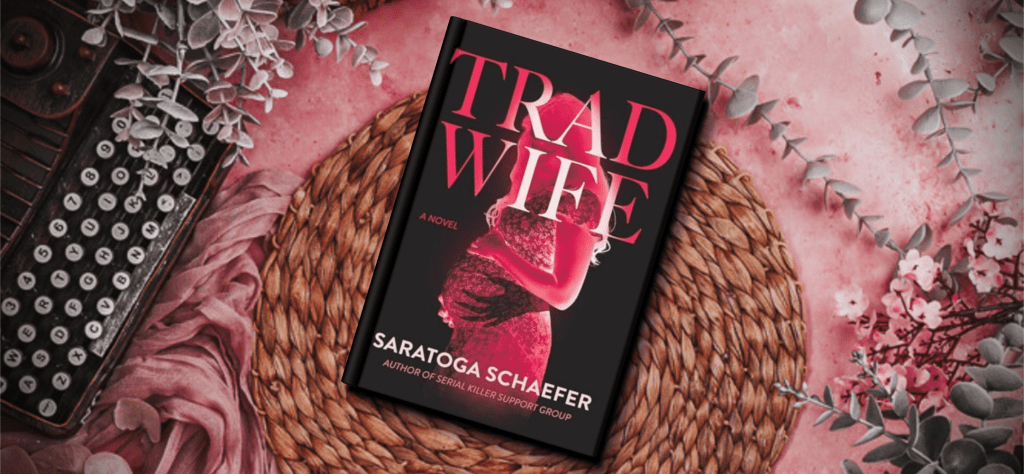
Title: Trad Wife
Author: Saratoga Schaefer
Release Date: February 10th, 2026
Pages: 309
Genre: Horror
GoodReads Rating: 3.82 ★
DISCLAIMER: This article contains affiliate links. If you click any of the links and make a purchase, I earn a small commission at no extra cost to you. As an Amazon Associate, I earn from qualifying purchases. Thank you for the support!
Media satirizing the idea of the “tradwife” has become a trend in publishing recently across genres, but it’s unsurprising that it’s been gaining a particularly strong foothold in the horror space. In some ways, it’s a natural fit. There are parts of a tradwife lifestyle that horrify many women: the servitude, the fear of partner violence, the inability to escape due to financial pressures. Initially, I thought that Trad Wife by Saratoga Schaefer would be a bit of a pulpy, unserious take on the genre, but I like the cover quite a bit and was willing to give the book a chance. I was surprised by how thoughtful and layered the commentary was, and I ended up enjoying the book much more than I thought I would. Schaefer effectively uses the horror genre to explore the idea of a trad wife lifestyle, and wrote an excellent horror book in the process.
Camille Deming has the perfect traditional life: a handsome husband who has a great job, a gorgeous country farmhouse, and a burgeoning Instagram following to share it with. She cooks, cleans, and takes photos to fit the precise aesthetic of her social media heroes, but she’s missing something vital. All Camille needs to complete her perfect image is a baby. She and Graham have been married for over a year, but pregnancy hasn’t followed, and Camille’s eager followers are becoming impatient.
While exploring her homestead, Camille discovers an old well on the border between her wheatfield and a dark forest with an ominous aura. She doesn’t see the harm in engaging in superstition, wishing into the well for the one thing she wants more than anything else: a baby. Something, deep in the darkness, hears her wish and answers. A visit from an “angel” answers her prayers. Camille is pregnant.
Her dreams of being a perfect tradwife are so close to coming true, but the pregnancy might not be exactly what she hoped for.
Characters
Camille as a character is a highlight for me. She isn’t likable by most metrics, but her characterization is extremely interesting. Many storie that features tradwives create a character who is extremely young and naive, often not knowing anything different from the traditional lifestyle. Camille doesn’t fit this mold. Before marrying her husband, Graham, she was in university and was a talented, up-and-coming scientist. However, despite her talent, her father never supported her ambitions. Camille’s mother died, and her father encouraged her to essentially take his wife’s place by performing all the cooking and cleaning for the household. This lack of support, combined with some harsh criticism of her academic work, caused Camille to flee from her life of academia due to her fear and insecurity. She fled away from the aspects of her life that brought her pain and into the aspects that brought her praise: cooking and cleaning. That’s more complex characterization than what I was expecting.
I also found it quite interesting that Camille is not necessarily entirely naive about the “angel” who impregnated her. She doesn’t believe it was truly an angel at any point in the story, despite her best efforts to convince herself. It’s much more compelling that she struggles with these thoughts rather than blindly accepting that she was visited by an angel. I believe it makes the reader more connected to her as a character as well because we know that she was not visited by an angel from the very beginning, so we’re not constantly waiting for Camille to catch up with our understanding.
It’s difficult to like Camille at times because she is extremely complicit in her own subjugation. No one is forcing her to be a traditional wife. She had a different path she could’ve followed. However, this remains true in our own world. Many of these women who post tradwife content on the internet make a lot of money. They are not trapped in these situations, most of the time. They defend their place in the family and their place in the world. So, how do we interact with these women? They can’t be forced to give up their lifestyle, and it’s likely that many of these women enjoy the position they are in. They feel like they are caring for their families; they feel like they are needed. However, it’s impossible to deny that many of these women espouse the narrative that it is a woman’s place to be in the home and it’s a woman’s place to obey her husband. This is regressive, obviously, and it can quickly spiral into more sexist notions, like wanting to repeal women’s right to vote. So, I ask again, do we fight for the women who willingly submit themselves to the subjugation of men, like Camille, even if they don’t want us to?
Graham, Camille’s husband, is more of a concept than a man, but I think that works extremely well for this kind of story. In a good amount of tradwife content online, the husband exists as a barely-there background entity, only appearing on camera to taste some freshly baked cookies. It’s reasonable, then, that Graham exists to Camille as more of a status symbol than a man. She cares that he’s handsome, she cares that he makes good money, and she cares that he would be able to provide her a baby. Her attraction toward him exists in the realm of him being a provider, which pigeonholes them further into this traditional dynamic: provider and homemaker.
Graham is also extremely hateable. His careless disregard for Camille’s desires and her work was both realistic and unsurprising. Domestic labor is drastically undervalued, so it felt very realistic that Graham expected so much from Camille without acknowledging the actual work that went into those results. The similarities between Graham and Camille’s father added an additional layer to their relationship. Camille went from seeking praise from her father to seeking praise from Graham without building any self-esteem outside of the approval of men. It’s no wonder that Camille acts the way she does. Graham’s infidelity is also just an accepted fact of life for both parties. Neither Graham nor Camille value Camille enough to acknowledge the cheating and stop it. It’s also unsurprising who Graham was cheating with. Conservative men often do not “want” conservative women, and being a tradwife doesn’t stop Camille’s husband from straying.
I never thought that the most likable character in the story would be the “angel.” He was very well-described. It’s almost like he was made from the well that he came from— stony and mossy and damp, but not necessarily in an unpleasant way. After impregnating Camille, he continues to check on her, was there for the birth of his child, and provided for both the needs of Camille and the baby. Honestly, he was a great dad and partner. Also, apparently, he was a great lover. Can’t ask for much more than that, can we?
Writing & Atmosphere
Schaefer clearly researched a significant amount of tradwife content for this novel. The aesthetic was perfect, hardly exaggerated at all from the real imagery, filters, captions, and comments that fill these accounts. I also appreciated that the fixation on the aesthetic drifted away as Camille’s idealized vision of these tradwives shattered.
The descriptions were vivid and interesting. I especially liked the emphasis on what Camille was smelling. This might be too personal of a detail, but these are my reviews! Personally, whenever I’m hormonal or about to be on my period, my sense of smell gets so much more heightened that I feel like I can smell my own skin, and I imagine it’s much, much stronger for pregnant people and during postpartum. The description of the “Eye” that Camille sees above her head during her sleep paralysis was also excellent. It brought to mind the idea of terrifying, biblically accurate angels with the infinite movement, penetrating gaze, and burning flames.
I’m not generally shocked by horror books anymore. I read a lot of them, but I was actually genuinely surprised at some of the descriptions that Trad Wife contained. The idea of drinking blood isn’t that far-fetched, but Camille literally cutting off small pieces of her flesh to feed her baby was… a lot. In a good way. It’s also such a good metaphor for mothers removing parts of themselves to fit the mold of motherhood and properly care for their children. It’s not necessary to lose yourself to care for a child, but to care for a child within the framework of being a tradwife, it becomes necessary. I’m reminded of Ballerina Farm, a very popular tradwife who had to convert her personal ballet studio into a classroom to homeschool her children. It’s a well-done piece of symbolic writing.
Plot & Pacing
The pacing moves along steadily. I never felt bored or impatient, despite the fact that a solid portion of the plot is focused internally on Camille. The story is, overall, about the ways in which Camille is changing physically and mentally, so I could see a reader who doesn’t enjoy character-based stories becoming a bit disinterested after a while. There were enough new events happening to keep my attention throughout the story, though.
The book was a bit predictable, but I believe it’s supposed to be. For example, Graham’s infidelity is quite obvious from the very beginning of the story, to the point that Camille knows about it as well. She does exist in a bit of denial, but she mentions that she can smell another woman’s perfume or she notices that his lips are “kiss-bruised.” So, when she finally discovers the affair, both she and the audience feel the same level of quiet resignation. The eventual ending of their relationship also felt inevitable to me, but I didn’t mind it because it was the proper place for the narrative to culminate.
I wasn’t expecting so much of the book to happen post-birth, though. I’ve read a few of these pregnancy horror stories, and it seems like they mostly end once the baby is born, leaving the nature of the child up to the viewer’s interpretation, but Trad Wife follows Camille through the experiences beyond pregnancy. I do believe this is important for the idea the book is discussing. Specifically, the idea that a baby would fix the marriage between Graham and Camille is being challenged, and the reactions on social media to the child challenge Camille’s perception of the tradwife lifestyle.
I also quite liked how much of Camille’s life truly does revolve around her social media. She views so much of herself and her life through the lens of a camera, and the way she describes herself in her internal monologue often follows this. Social media never becomes a background part of the story because, in many ways, the influence of social media is what the novel is interrogating. I don’t love when stories have an influencer protagonist who never seems to use or engage with social media— I’m looking at you, Play Nice. Even to the very end of the story, Camille has to cut ties with the world online in a permanent way to really become who she is trying to become.
Themes
There’s a dynamic here that I don’t see in media very often that I quite liked. It’s relatively common that people who are in an abusive marriage or relationship will begin a relationship with someone else before the official dissolution of the previous relationship. A lot of people would consider that unethical infidelity. I don’t necessarily believe that it’s as black and white as that. Especially in a dynamic like that of a tradwife, the stay-at-home spouse might literally have no work experience, no education, or no money. The only way they would be able to leave the dynamic, then, is by having another partner lined up. I liked that this reality is what Trad Wife portrayed. Camille is only able to leave through the support of the Angel.
So much of the novel is about the performance of gender, specifically within the idea of Christianity. The religious themes run deep, with both Camille and Graham using religion to hold Camille to the roles she is “supposed to” remain in. Camille continuously tries to frame her pregnancy as a gift from God and the creature that impregnated her as an angel, despite being a woman of science and not particularly believing it. Even at the end of the story, Graham is trying to maintain a religious high ground by asking for an annulment instead of a divorce, which would not have been allowed by his religion.
The religiously enforced gender roles are compounded by the socially enforced gender roles through social media. The wives do their “womanly duties,” cooking, cleaning, and submitting to their husbands, and they encourage others to do the same. The comment sections keep these women contained to the strict idea of what a godly woman should be and do, including the pressure on Camille to have a child. It becomes a feedback loop that’s impossible to escape, but it’s also all performance. These tradwives are often the breadwinners in their households. Many of them have nannies. They’re performing a perfect version of femininity that provides an unrealistic example for both men and women of what a relationship would look like, and the one who is punished, socially but also occasionally abusively, is always the woman.
“I remind myself I’m one of the lucky ones. My husband loves me. He would never hit me or scream at me.”
Trad Wife (2026)
It’s not possible to maintain the performance all the time, and yet, the tradwives expect the audience to believe that it’s not a performance, and that’s where their true insidiousness lies.
The fact that Camille has a daughter is also such an important part of the story. It forces Camille to deeply consider the roles that she is imposing on herself and whether she would find these roles acceptable to force onto her daughter. In Camille’s mind, this is the only way of life that she’s good at. It’s the only way of life that the people around her have told her is acceptable. To a certain extent, Camille believes she deserves the subjugation because she has “failed” in the other way of life, but to commit her daughter to that same subjugation is unconscionable regardless of her daughter’s successes or failures. It’s the final piece that breaks her away from her mindset.
“Maybe I don’t want to raise a traditional wife. Maybe I want to raise a feral woman.”
Trad Wife (2026)
Recommendation
I would absolutely recommend Trad Wife. Not only was it a fun, gory horror story, but it also had something important to say about the nature of being a tradwife. It was a quick read that easily kept my attention and had me dying to know what would happen next.
Trigger warnings:
Alcoholism, animal death, blood, cannibalism, childbirth, gore, infidelity, misogyny, murder, pregnancy, self-harm, violence