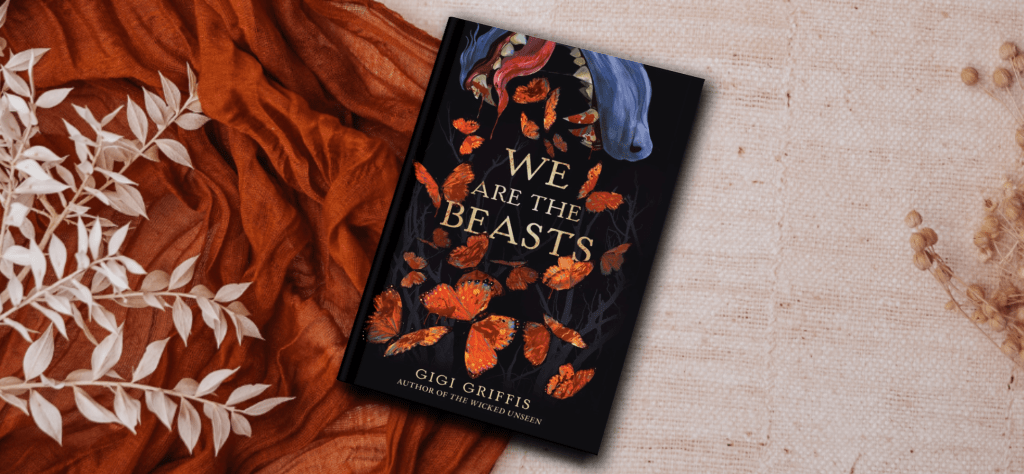
Title: We Are the Beasts
Author: Gigi Griffis
Release Date: December 10th, 2024
Pages: 352
Genre: YA Horror, Historical Fiction
GoodReads Rating: 3.68 ★
My Rating:
This review contains light spoilers for We Are the Beasts by Gigi Griffis
I initially applied to get We Are the Beasts as an ARC! I think it was literally the first book I applied for on NetGalley, and I was super bummed to have not received it. The whole thing seemed right up my alley, from premise to cover, so when I saw the book in stores and, more importantly, available at my local library, I had to pick it up. A chance to see what I had missed out on a couple of years ago.
Something is killing in the French countryside, and those who have seen it can only describe it as a beast. It’s massive and vicious, and no one has seen anything like it before. Theories run wild, from a giant wolf to a shapeshifting witch to the wrath of God made manifest.
Josephine and Clara are sheep herders trying to keep their flock and themselves safe amidst the chaos when they discover the body of a teen boy, supposedly ripped apart by the beast, but the boy’s little sister tells a different story. Realizing she’s in danger if she stays in the town, Josephine makes the snap decision to fake this little girl’s death and blame it on the beast. Clara and Josephine see an opportunity to save the girls in their town who are in a different kind of danger, danger from the men who desire to hurt them. Using the cover of the beast, they might just be able to free these girls.
The characters were fine. Josephine has some compelling depth to her character, and I appreciated the way the flaws in her character manifested. She’s bold but a bit reckless, diving in to help before she fully has a plan. It made her feel appropriately sixteen. Her desire to help others was admirable, and it softened some of her harder, more unlikeable edges. Josephine does do some truly dumb things, but they fit well within her personality, so they didn’t annoy me really.
Clara is a good foil for her. She’s more level-headed, more likely to have a plan, and more socially tactful. Their friendship feels very natural, and the way their relationship evolved also felt very natural. I don’t want this to come across the wrong way, but I do generally prefer in historical fiction to have subtler implications of sapphic feelings rather than full love confessions. I didn’t really need for Clara to come out and declare that their feelings for each other were romantic because those feelings were portrayed well enough in their actions for each other, through kisses and dialogue. It’s one of those aspects of the story that felt a bit “young adult.” I appreciate representation for this age demographic, but I also think we should trust them to be able to pick up on subtext without explicit coming-out scenes in every book with a gay character. There is more than one in this book alone.
The sheep were honestly my favorite character, although I do wish that Josephine had given her little troublemaker lamb a name instead of relentlessly referring to him as “my fool lamb” for the entire story. Even a term of endearment would’ve been better, like ma grand. I like that Josephine clearly has respect for her sheep and a desire to protect them. It adds to her characterization as a shepardess. I wish that characterization could’ve overlapped a bit more with her treatment of the girls she’s saving.
I’m never going to be opposed to a story about women recognizing the oppression that exists in the men around them and working within the bounds of their roles to fight that oppression. That being said, this book has a real problem with its portrayal of men. I understand at this time in history women were considered little better than property; however, there are very few positive male characters in the story. There is one, a boy who ends up being gay, and so I have to wonder if the author then associates him with feminity. He even expresses a desire to wear a dress at one point, and while I don’t have a problem with this, it reinforces the idea that the one way women can be safe is within feminity.
All of the men in this story are greedy, boastful, violent, sexual predators, or dismissive of the women. It got to a point where it was a bit over the top and unbelievable. More than that, none of the men in the story truly get a chance to be characters. There is almost nothing learned of the hunters that are sent to town to hunt the beast. I don’t even remember their names because they ended up being so insignificant. The priest, who is a main antagonist, doesn’t even get a name. He’s exclusively called “the priest” despite being the main villain. If the author doesn’t take the time to flesh out these characters, the book feels less. It feels like another generic “female rage” book to capitalize on the popularity of the genre without nuance.
I think a part of that is this book is technically categorized as young adult. You do feel the “young adult” vibe while reading, and I can understand that a younger audience isn’t necessarily looking for the nuance I want, but I’m imagining a young man reading this book and coming away with the “all men are bad” feeling that this book is projecting. Proximity to feminity is not proximity to goodness or righteousness, and I don’t think we should be telling young adults otherwise.
While this book is set in the late 1700’s Josephine does sometimes speak in a way that pulled me out of the setting. For the most part, the book maintains that sense of time, which I think is utterly vital in historical fiction. Some of the time, though, I found the writing to be very awkward. For example:
“The day LaFont arrives is the day the beast strikes again. This time, I believe, for real.”
We Are the Beasts (2024)
I don’t know enough about how people spoke historically to know whether or not someone would say “for real,” but it’s one of those things that feels anachronistic. I could very well be wrong. Some phrases and even names are much older than we associate them being. Tiffany, for example, is a name that has been around since the Middle Ages. All I know is that reading a teenage girl in a book saying “for real” instantly broke my immersion.
Another example:
“I wasn’t planning on going after the beast, but this disdain for the idea that a girl could be the one to take it down is misplaced as hell.”
We Are the Beasts
Again, maybe this is something that a French peasant in the 1700’s would say, but I sincerely doubt it. Josephine is a bit blasphemous for the time period, constantly saying “Mon Dieu,” meaning “My God.” This would be considered on par with swearing and considered quite offensive to general sensibilities, but I’m not sure even she would invoke hell so casually.
Beyond that, the prose can be very compelling. The author does place the reader into scenes well, and there are some moments of genuinely beautiful imagery. Unfortunately, I think that as the book went on, the author was less interested in creating these moments. At the beginning of the story, there’s a scene where the girls come across a dead body, covered in butterflies whose wings have been stained red with blood. That’s an insanely cool, vivid image, and it creates an almost supernatural or storybook feeling that doesn’t continue at all through the rest of the narrative.
The pacing of this novel felt both too quick and monotonous, and while I didn’t find that entirely unenjoyable, it did feel a bit like the plot was moving around in circles. It doesn’t help that Josephine and Clara don’t have any time to really plan. They’re moving on instinct for the entire story, so it feels less like two clever girls using the cover of the beast to save the girls of their town and more like two teenagers getting extremely lucky over and over again. I understand that it’s part of the theme of the book that these girls are constantly being underestimated by the men around them, but it felt less like these girls were intelligent and more like every single man around them was a blithering idiot.
The ending was so chaotic to me. There were essentially two climaxes, and only the first felt satisfying. There are two main threats throughout the book: the town and the beast. I can imagine that the author wanted to have neat bows on the conflict for both, but the problem is she combines them for one climax that is exciting and thematic and then for some reason has a second climax following just the beast that unravels so much of the theme.
The girls are clever enough to use the idea of the beast, and even the beast itself, to defeat the townsfolk, playing into their fears. It’s an acceptance of their wild, untamable side and a demonstration of how powerful that side of them can be in the face of oppression. It creates a kindredship with the beast, places them on the same side as the creature, which technically they’ve been doing for the whole book by using the beast as cover, and ties into the title: We Are the Beasts.
So then, you can imagine my disappointment when they then turn around and try to fight the beast.
The Beast
I’m not really certain if I should spoil the twist of what the beast actually is. On one hand, the story is a better experience if you are wondering about what the true nature of the beast could be, whether it’s supernatural or a creature or a human being. However, on the other hand, I do find the execution of what the beast ends up being to be lacking. I find it unbelievable that the people of this town are unable to connect the beast to something they are familiar with because, without spoiling it too much, this kind of animal has a wide variety of related creatures that a French peasant would be able to compare it to in movement and appearance. I will say that I was able to guess what the creature was before the big twist.
I kept thinking that the explanation was going to be much more fun or interesting than what we actually ended up getting. I kept thinking of theories: maybe the beast was a werewolf, maybe it was Josephine’s father who had abandoned her, maybe it was a serial killer, maybe it was a witch. When I finally understood what the beast was, I immediately lost most of my interest in it.
I also didn’t really like the group fighting the beast. I felt that it conflicted with the themes of the story, even though the author tried to make it into the culmination of those same themes. The author wanted the reader to feel like the girls were just as ferocious as the beast and, in doing so, pit them against it, but if the beast was a symbolic representation of the girls, of femininity, of motherhood, then the final confrontation is pitting women against women, not against the men trying to harm them. Rather than confronting the issues that were present in the town, the corruption, violence, and oppression, symbolically they are fighting themselves. It’s confused! And aside from that, I just felt bad for the beast. I didn’t like seeing it injured, especially because it’s not some evil monster. It’s just trying to survive, like they are.
Though I found myself disappointed by We Are the Beasts, I might still recommend it to the right reader. I liked the characters well enough, the intrigue of what might happen next kept me interested enough to keep reading, and the writing was passable. High praise, I know. I would just recommend reading with a critical eye towards the themes and ideas that the book presents.
I did also read the author’s note where she went into detail about the real-life case that inspired this book. It’s super intriguing, and I might see if I can find some nonfiction material about the Beast of Gévaudan.
Trigger warnings:
Sexual assault, violence, murder, blood, death of a child, animal abuse, misogyny, domestic abuse, religious abuse, starvation.