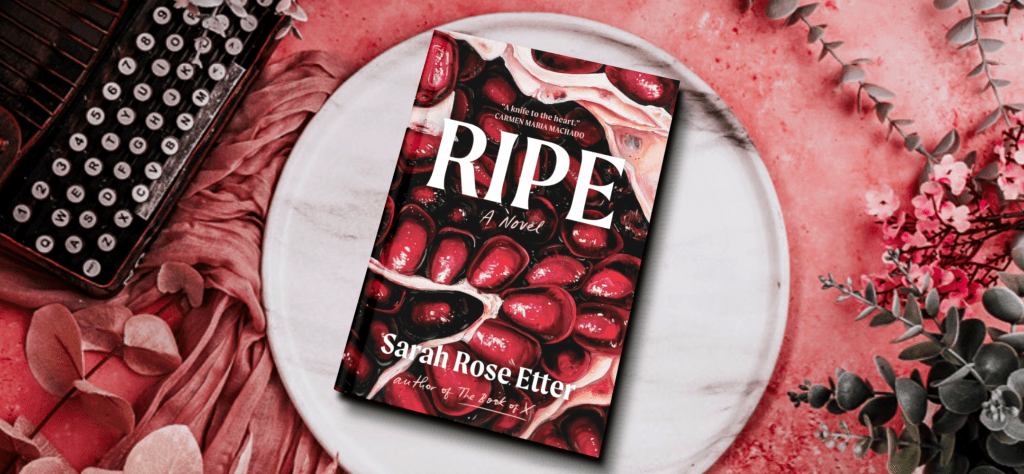
Title: Ripe
Author: Sarah Rose Etter
Release Date: July 11th, 2023
Pages: 288
Genre: Literary Fiction
GoodReads Rating: 3.58 ★
My Rating:
This review contains spoilers for Ripe by Sarah Rose Etter
Sometimes I’ll read books the same month that I add them to my reading list, but some have been there for going on three years now, and Ripe was one of those books. I think that the genre of literary fiction is one that is tied to my mood, because it can be… a lot. And Ripe was certainly A LOT. I was very intrigued by the upfront confrontation of capitalism that was suggested by the description, and even more so to examine how the book interrogated the ideas of women, motherhood, and pregnancy into that narrative.
Cassie works for one of many tech startups in Silicon Valley, though she doesn’t count herself amongst the Believers. She thought this job would provide her stability, stock options, and room to grow out of her small hometown, but the breakneck speed the company expects her to maintain is beginning to fray her at the edges. Then, she finds out she’s pregnant.
Cassie has a secret. She has a companion that only she can see that has never left her side, through the good times and the bad. A black hole. Her own personal black hole that grows or shrinks, stretches or warps, to fit with her emotional state. Cassie feels the cold draw of the black hole, but she has no idea where it may lead her. She tries desperately to make a life worth staying for, but the black hole is always just behind, offering another way out.
Characters
The characters in this book are pretty over the top, but I didn’t really mind it. In my opinion, they’re supposed to be thematic representations of people rather than actual people. This is most obvious with the characters that don’t receive names, like the CEO or the Chef.
The whole novel is about Cassie. Cassie is in her thirties, and began working at tech startup VOYAGER about a year ago at the beginning of the story. She’s absolutely drowning in her role, and she can’t seem to catch a break. She just keeps telling herself that things will eventually get better, but she’s hit with bad news after bad news. Cassie is barely hanging on. I liked her well enough as a character, but I do think despite her honesty, Cassie keeps the reader at an emotional distance. I felt bad for her, but I did at times feel like she was disconnected from her own emotions, telling the reader about the events that happened rather than feeling them. She’s in such a difficult financial position, and there’s not really much she can do about it. Cassie already has what most people would consider a fantastic job, but there’s an intense amount of competition in this city. She doesn’t have the savings to quit, doesn’t have the time to find something better, and doesn’t have the guarantee that she could, even though she’s already earning six figures. It’s a really frank look at the insane cost of living.
Sasha is the character that interests me the most beyond Cassie. She’s Cassie’s boss at VOYAGER and one of the cofounders of the company. I’m not going to go too far into her character here because I believe most of her function within the story is to be a commentary on female capitalists and the women who “made it” within the system. She is one of the characters that I think makes the reader feel the most conflicted. She’s awful, like any boss, but she’s also sympathetic in a way many other characters are not. The sympathy never takes away from her vileness, though.
Jeremy is a character that I thought would play a larger role in the story, and I’m a little disappointed I didn’t get to see more of him. This character could’ve been a parallel to Cassie because they work in the same company and on the same secret project, specially recruited by the CEO. The author could’ve shown the dichotomy between the two as Cassie feels more and more internal conflict about her role in the company. Perhaps Jeremy could’ve fallen down the pipeline to become a Believer at VOYAGER while Cassie becomes more jaded. I would say this does happen but on a very surface level and with far fewer interactions with Jeremy than I had been hoping for. There was even the implication of him being a love interest, which never really went anywhere.
The actual “love interest,” if you could even call him that, is the Chef. Cassie never refers to him by name, and although she is in love with him, she maintains her emotional distance because the Chef has a long-term girlfriend. Cassie knows that she will never win in the battle for his love, despite becoming pregnant with his child, and it validates her worldview that she will never be truly loved by anyone. Their story is quite tragic. The Chef seems like a good guy! He brings her out to nice meals, cares about her day, and is gentle and sweet, but he’s a taken man. Cassie knows this; he was very upfront about everything when they first started hooking up. Him being unavailable also cuts Cassie off from financial help. It would be easier for her to afford her life in San Francisco on two incomes, and it is clearly impossible to survive without, but that’s not an option with the Chef. I think the choice to not give this character a name was a great idea. He’s a representation of a “normal” life, but both Cassie and the reader are denied the emotional intimacy required to have that normal life.
The CEO is another character that doesn’t receive a name, but this is because he is VOYAGER. As far as Cassie is aware, he doesn’t exist outside of the confines of the company. He only thinks about how to make the company bigger, better, and more profitable. More like an algorithm than a person. The CEO has no scruples, no concern for the law, and no concern for the employees. He is capitalism personified. He also has this little rat guy who is his protégé that I HATED, but he was made to be incredibly hateable. This little rat thinks he’s Cassie’s boss, despite him having no authority over her, and because he’s the CEO’s pet, he thinks he can make demands of her and threaten her. I think that this could be partially because he is a man and she is a woman, so in a patriarchal hierarchy she is beneath him, even though they are technically equivalent at the company. Cassie observes that he is being groomed to take over VOYAGER and become one of the “small gods” of Silicon Valley.
I think Cassie’s parents, while they play a small role, are such an interesting part of her character. Her mom is a narcissist who is described as constantly “stinging” her daughter, though I appreciated that her mother is not the source of her black hole. It would’ve been overly simplistic to blame one woman for Cassie’s damage, and I’m so glad the author moved in a more grounded direction. Cassie’s dad is more fascinating to me. She seems to have a closer relationship with him, and he’s supportive on the surface, but I believe that he plays a huge role in how trapped Cassie feels. When she graduated high school, he immediately made her move out and said that she was never going to be allowed to move back in with her parents. This is a fairly standard action to do to your adult children in the modern age, but what it means practically is that Cassie has no safety net. When she realizes that she made a mistake moving to San Francisco, she has no way out. She had no money to move away from the city and nowhere to move back to. There is no money, no savings, so she can’t put a security deposit on a new apartment. While Cassie’s dad holds a positive position in her mind and memories, he is a major part of why she feels so caged. Maybe the events of the story wouldn’t have happened if Cassie had a different way out…
Writing & Atmosphere
The writing is very literary. It can be a bit rambling and circular, though that’s all in service of creating a specific atmosphere. The descriptions of San Francisco make it sound like literal hell on Earth, though I’ve never been. Maybe that’s accurate. At the very least, it’s accurate to how Cassie feels about living there. The atmosphere in general is… frenetic is maybe not the correct word, but it’s the one that comes to mind. It’s stressful and exhausting, which puts the reader firmly in Cassie’s point of view.
At times the writing became a bit repetitive, especially in regard to the black hole that follows Cassie throughout her entire life. On one hand, I could understand this as a narrative choice because we are experiencing the black hole as Cassie does. It’s always with her, so it’s always there on the page. That being said, at any instance that Cassie feels any emotion, we get a description of what the black hole is doing, and it’s never behaving in a way that is shocking or new. If she’s upset, it’s bigger. If she’s fine, it’s smaller. That is never subverted, so describing both her emotion AND the black hole every time is unnecessary.
Ripe did have this really odd writing quirk for the first chapter that I’m incredibly grateful didn’t persist for the entire story where, for some reason, instead of describing the scene, the author used a colon to list things instead. People, objects, details; it didn’t matter. For example:
“But the train jolts forward, shattering the sensation. We snake past: junkyards full of busted metal, worn-down bamboo gardens, abandoned car lots, the grinning strip mall teeth of the suburbs, the doors of coffee shops and gas stations opening for the day, capitalism in slow morning bloom.”
Ripe (2023)
That’s a lot of things to list in choppy, quick succession. Would you believe that it’s immediately followed by another odd listing nearly identical to this one? Because it is. At least four times in the opening chapter or two this pops up, and it was so unengaging. There is some compelling imagery here, like the “grinning strip mall teeth,” but I was very worried for the rest of the writing. Luckily this quirk is dropped very shortly into the story, though the author does still use colons at a rate I’ve never seen before or since. It’s not egregiously noticeable.
The fruit imagery throughout the story is what stands out the most to me. Cassie describes herself and the world around her repeatedly in the same terms one would speak about fruits. She thinks about the appearance of a ripe, beautiful fruit versus the rot that bursts into your mouth once you break the surface, and it’s a good metaphor for the way she viewed her life in San Francisco before and after beginning to work at the tech startup. At one point the Chef helps to show her how to break open and eat a pomegranate: a representation of how he can break through her image and make her feel vulnerable in a way that no one else can. It creates a thematic throughline that helps to draw together some of the more disparate moments of the plot.
Plot & Pacing
Not that there is very much plot. If this is your first literary novel, take it as a lesson about how much plot is typically in this kind of story. Very few events actually happen, as the real story here is in how Cassie feels and interprets her life.
Each chapter begins with a definition, anything from “black hole” to “mother,” and then the following chapter is split into two sections. The first is a segment that takes place in the past as Cassie thinks about how that chapter’s word has affected her life. These are the most internal sections of the story. Cassie’s thoughts and observations about life are explicitly spelled out, providing more backstory and fillling in her character. Then, after a page break, the current timeline continues. These sections were quite short in comparison.
The summary on GoodReads goes into some detail about the “illegal actions” Cassie’s boss is asking her to take, and while that is a part of the plot, it’s not as significant as it first seems. Yes, Cassie is being asked to engage in illegal activity against a competitor, but it doesn’t provide very much tension or mystery or conflict. The only conflict that arises is within Cassie’s feelings about herself. She wants to feel useful and she’s good at this sabotage, which makes her question who she is and who she wants to be. It’s possible that she would advance within the company, become indispensable, but she would become Sasha.
I started to write a whole paragraph here about the ambiguity of the ending, but I don’t think the actual ending itself is ambiguous. To me, at least, it is extremely obvious what happened, but the language is very metaphorical. There is some room for reader interpretation, and if a more dreamy ending is not something you enjoy, I think you could end up frustrated here. Cassie’s ending was a very logical conclusion to her character; I had predicted it very early on in the story, but that doesn’t take away from the emotional impact. It was like a train wreck you could see coming from miles away. You hope it can be avoided, but when the impact comes, it hits hard.
Themes
Thematically, Ripe is a Sisyphian story, except the gods keep adding more weight on top of the boulder. Cassie is already barely keeping up with the demands of her workplace, and even though she is objectively succeeding with the workload she is given, she is made to feel like a failure. She’s repeatedly berated by her bosses for mistakes they made, or “asked” to do additional work outside of the nine-to-five hours. Nothing is ever good enough for them, and I could see the straight lines between the actions of these characters and companies in the real world. Every year sees record-breaking profits, and every year there are massive layoffs, products get worse, and shareholders get richer.
Capitalism inherently does not care about the employee within the system because the ten minutes the employee was on break are ten minutes of lost productivity. The 1% bonus to employees is profit the company could’ve kept to make their stock look even better, so they don’t give out bonuses anymore. Companies are exclusively incentivized to become worse and more exploitative in the name of profit, and Ripe is such an excellent portrait of someone caught so entirely in the gears of this machine. I cringed as Cassie’s Saturdays were eaten up by a mandatory coding bootcamp her bosses signed her up for, even though her role as Head of Marketing requires zero coding. My heart broke as her Sundays, her last day to herself, were stolen by strategy meetings. Under capitalism, to be successful, the employees must be infinitely more productive to make their company infinitely more money, until something breaks. Usually, that something is the employee.
Cassie also experiences a feeling that I often do, which made the story feel more personal. Everyone around Cassie seems to be doing life better than her. All of the other employees at the company are so thin, so pretty, so “happy.” How is it that everyone seems to be able to live this crushing life and do it better than Cassie? She feels defective. She blames herself for the weight of work her bosses place on her because everyone else seems to be doing fine. But Cassie puts on a fake self to talk to these other employees and project light and confidence. The reader can infer that these other employees, these Believers, are not doing well either. No one thrives under this system, and we can see that with Jeremy.
Though Jeremy is described as hot and put together, he lives in a small RV just outside of the company building. He doesn’t have the money to afford an apartment in San Francisco, and while Cassie is able to relate to him in the beginning and even form the beginning of a friendship with Jeremy, he takes the first opportunity to advance his position. He joins the squad that is using illegal means to take down their competitor. He provides ideas and resources. Cassie sees the change in him as he goes from a “Believer” to one of the “small gods,” someone with power and influence. Jeremy won’t change the system, but he’s found his leg up in it and he only had to sacrifice his integrity.
“You wake up one day and realise what you’ve become, what you allow, and you have to stare down into the pit at yourswelf, at your own choices, at the way to which you have been cunning and stupid and false and wretched to keep up with the world around you.”
Ripe (2023)
The author dives deeper into this idea by specifically interrogating the ways that capitalism affects women. Cassie’s direct boss, Sasha, is one of the co-founders of the company, and yet she receives no respect at all from the other male executives. They dismiss her, ignore her, and don’t allow her to speak at company events. Despite this woman theoretically having the power in the capitalist system, it doesn’t override the patriarchal power structure. She is still “just a woman” despite selling out the same way the male employees do. She will never have the opportunity to become a “small god,” no matter what she sacrifices, and I think that sinks in for Cassie. As women, they will always be fodder for the machine.
Sasha’s body is also particularly focused on throughout the narrative. She clearly has a very restrictive eating disorder, and I think it would be easy to argue that this is at least partially fueled by her position within the company. Sasha needs to be perfect, and that includes having a perfect, thin body, to deserve respect. It’s revealed later in the story that Sasha is going through fertility treatments to become pregnant, and it’s not working. All the money in the world won’t be able to allow Sasha to become pregnant if she’s incredibly stressed at work and too thin to maintain fertility, and yet she doesn’t take any time off. Sasha, theoretically, is in one of the safest positions in the company in regards to layoffs and she still fears that her position will be lost. She wants control, of the company and of her body, but the capitalist machine denies her that control.
These ideas are an interesting intersection between capitalism and feminism that we often see in our current world. Women have to be women who “do it all.” We’re both expected to have children, but also expected not to let our performance slip at work. If you work too much, you’re a bad mother. If you don’t work, you’re a burden. Many companies still engage in discrimination against women regarding pregnancy and motherhood. Men argue that women SHOULD earn less in the workplace because they take more time off for their children, as if that’s not a direct result of women being viewed as the default caretaker. Women in the United States have no guaranteed maternity leave, meaning a woman could give birth and be back at work the next day, still bleeding, and capitalists would rather it stay that way. Every day you’re off is lost profit for them, so bleed out in the offices.
Cassie is also pregnant, unintentionally. She is so caught up in the speed of the grind that she doesn’t take time to really process this fact. She’s in denial about it for weeks, to the point where I started to become worried about her options, and the whole time she is drinking and taking drugs. I’m not saying this to sound insensitive, but I could see Cassie’s body as a metaphor for capitalism, moving too quickly and recklessly to consider the effect on those within it. Cassie deeply worries as well that her child would be born with a black hole of her own, and would have to suffer the same way that Cassie does.
Cassie has always believed in the inevitability of the black hole sucking her in, and so the actions that she takes in this book could be seen as a struggle against destiny. She doesn’t necessarily want to enter the black hole and give up her life as she’s always known it, but the black hole is a black hole. It has an undeniable pull that Cassie has to fight every minute of every hour of every day. In my opinion, the black hole is a representation of Cassie’s clinical depression. It might have been possible for her to resist its call if she were more supported in the world, but when there isn’t a lot to live for where she is, it makes sense she would choose otherwise.
Recommendation
I wouldn’t exactly say that I “enjoyed” Ripe. It’s a story that’s filled with desperation and despair, but it connects with a feeling that anyone who lives under our current stage of capitalism has felt at one time or another. This is not a feel-good book; it’s not a Lifetime movie where the big-city girl moves to a small town and finds her passion for life again. It’s a story about someone being crushed under the weight of the world. I think a reader should be very careful reading this book because I genuinely believe it could put them in a bad headspace. At the same time, Ripe was fascinating and even cathartic in an unexpected way. I’m just saying “know thyself” before you dive into this one.
Trigger warnings:
Pregnancy, abortion, suicide, drug use, eating disorders, abusive bosses, anxiety, alcohol, homelessness, mental health episodes, fire/fire injury.