
This book is drowning in bad messaging…
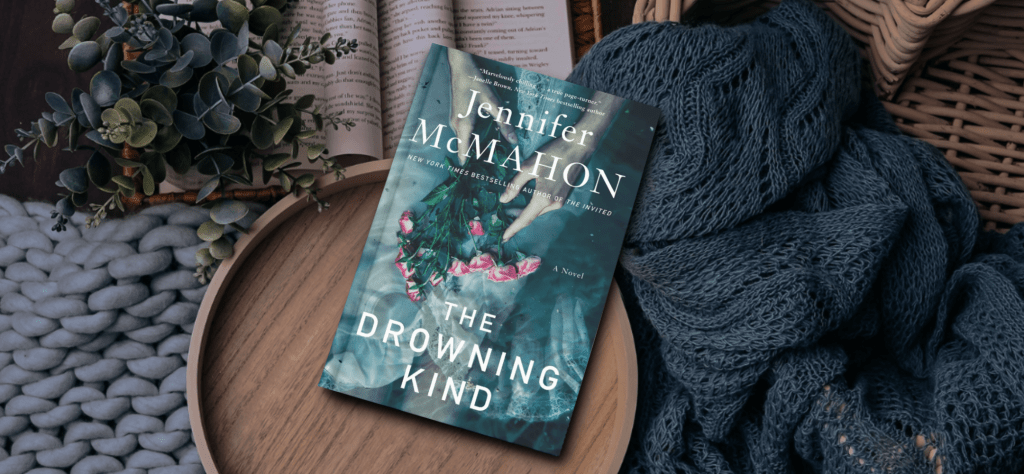
Title: The Drowning Kind
Author: Jennifer McMahon
Release Date: April 6th, 2021
Pages: 319
Genre: Horror, Historical Fiction
GoodReads Rating: 3.81 ★
My Rating:
This review contains spoilers for the ending of The Drowning Kind by Jennifer McMahon.
I read The Drowning Kind with my book club, A Literary Apothecary, and I am severely conflicted about my feelings. I think I’m angry. I’m angry that the author set up an interesting story with sympathetic characters and intriguing themes, and then pulled the rug out from under my feet so mercilessly that I’m still sitting on my ass wondering what happened. How did a book that started off so well end so poorly?
Jax, tired after a long day of work as a social worker, ignores her sister’s frantic, rambling phone calls for the night. Just one night. She promises herself that she’ll call back tomorrow and start the arduous process of getting Lexie back on her medication for bipolar disorder. The next morning, Jax discovers that Lexie drowned in the pool at Sparrow’s Crest, their grandmother’s old estate. At the house, Jax discovers a mess: notes that don’t make any sense, old, forgotten food, and puddles of water everywhere. She feels drawn to her sister’s notes, the last connection she’ll ever have to her, but Lexie seemed to be researching the springs that feed the pool. What she found is darker than Jax could’ve imagined.
Plot & Characters
The current timeline follows Jax dealing with the impact of her sister’s drowning in their family pool, a pool that has been in the family for generations and already claimed the life of her aunt when she was a child. Jax has been low-contact with Lexie for around a year for several reasons. Lexie has severe bipolar disorder, schizoaffective type, meaning that she can go through very intense manic/depressive episodes, and these episodes can escalate to include delusions and hallucinations. Jax has needed to accommodate for Lexie for most of their lives, including trying to convince Lexie to go back on her medication repeatedly and calling for her sister to be hospitalized.
After their grandmother leaves everything to Lexie in her will, Jax is hurt and needs space. So, she moved away and went low contact with Lexie for her own mental health. When Jax arrives back to Sparrow’s Crest, she finds it in shambles. It appeared like Lexie was going through another manic episode, and this one unfortunately led to her death. However, not all is as it seems. Lexie had become obsessed with the pool in the backyard, which was less of a pool and more of a pond. It’s always been fed by a natural spring, and Lexie believed that the pool was changing. She even wrote about people coming out of the water.
This part of the plot is much slower than the sections in the past. Jax spends a lot of time internally beating herself up over not knowing who her sister really was at the time of her death. It feels like everyone in town has a story about Lexie, knows about her hobbies or her art, and are subtly rubbing that in Jax’s face. The timeline of their estrangement also feels a bit off. I might be wrong about this, but I thought they had only been estranged for around a year. It feels like they’ve been estranged for ten with how little Jax knows about Lexie.
Jax is “investigating,” but I use that term very loosely. She reads some of Lexie’s notes, measures the pool once, but she really isn’t moving the plot forward that much. The “haunting” that is happening isn’t even really that present. This is definitely more of a suspense novel than a horror novel. Jax’s mental health degrades further and further, until the book tries to pull a twist? I don’t even know if the audience was supposed to believe the twist or if we were supposed to take it as further evidence of Jax’s decline because it was not convincing at all.
Jax’s plot ends horrendously, but I’ll get into that a little bit later.
Jax is a character that I personally relate to a lot. I have an older sister who is annoyingly good at everything: sports, academics, music, even socially. I was the little sister, always begging her to hang out and following in her footsteps. I understood the conflicting feelings that she had about being the younger sister. I also think that she was entirely justified in her feelings towards Lexie and the desire to get some space from her sister. I think she made the choices that were necessary to preserve her own mental health. Jax is a bit boring, admittedly. She doesn’t have a very strong personality, though that might be because she spends most of the book grieving. Jax is lost, and because of that she just comes across as alternating between being numb, nervous, and sad.
Lexie is only really characterized after her death, which is an interesting choice. Her family and friends talk about her at her funeral and her wake, but as people at funerals do, they only mention the good. Jax does make a point later on that everyone around her seems to bury the hard things, never talk about them, and I think that applies to Lexie, too. It seems like everyone in town has only had positive experiences with her, tasting her homemade strawberry jam and buying her professional quality watercolor pieces, and it makes Jax seem crazy. It also makes her feel guilty. The only times Lexie is talked about negatively is within Jax’s memory, which creates a very strange othering of Jax. I’m not saying Jax is perfect, but the more I think about it (and considering the ending of the story) I think this is a deliberate attempt to undermine Jax’s feelings about her sister.
The other characters are not given very much depth. Ted is Jax and Lexie’s father, and he’s in town for the funeral and memorial service, and he also has unmedicated bipolar disorder. He is fine as a character, though I do kind of hate him. When the girls were growing up, he was enraged that Lexie was given a diagnosis, “a label,” and he was categorically against getting her on medication, even though she was a danger to herself. He hasn’t changed his mind or reflected on that stance, even after Lexi’s death. As far as he knows, her bipolar disorder was a direct contributor to her death, and he still doesn’t even spare a thought to how he could’ve influenced that outcome.
Diane is in the story to simply be the voice of reason. She is not affected by the haunting, and is there to convince the other characters that they are crazy. Ryan is a man from the town who was childhood friends with Lexie and Jax. He firmly believes the spring was haunted and is part of the investigation into its past. He’s fine.
The past timeline begins in 1929 and follows Ethel Monroe. She’s a newly married woman who is desperate to have children with her husband, but as a year passes, and she still doesn’t fall pregnant, she becomes more desperate. To help relieve her stress and reconnect as a couple, Ethel’s husband Will books a vacation for them at a gorgeous hotel near the natural springs. Once they arrive, the hotel’s proprietor, Eliza, and Ethel become fast friends.
I liked the past plotline. It’s much shorter than the ones in the present, but it reveals a great deal about the history and “magic” of the springs. It’s easy to sympathize with Ethel and Will’s desire to have children, and I find all their actions in pursuit of that goal to also be reasonable. Ethel is already doing rituals to try to have a child, so the idea of giving her wish to the spring is just another step for her. The locals do warn them off the stream but with little evidence to support the idea that the spring is cursed. I’m basically just trying to say that Will and Ethel don’t feel like idiot horror protagonists.
I also was quite suspicious of Will at first. I’ve read too many thrillers to accept the nice, rich husband at face value, but I came to like his character. He’s a reasonable man, but when faced with no other option but the supernatural, he chooses to aceept, if not believe. Will does whatever he can to keep his family safe.
I should note here that Ethel engages in self-harm using a needle to scratch and poke her skin. It’s not graphically described, but it is something readers should be aware of going into this story. I don’t hate it as a part of her character, though whenever self-harm is included in books, I question it’s necessity. With such a sensitive and potentially triggering topic, I give the execution a bit more scrutiny. I don’t think the self-harm is relevant beyond showing Ethel’s mental state. Her husband never notices, it never leads to conflict, and it never “resolves,” not that I’m expecting it to. I’m simply pointing out that if Ethel kept a journal that she scribbled in while upset, it would have the same effect. I’d actually really love to hear other’s opinions on this topic.
Writing & Atmosphere
The writing and atmosphere are where the book really shines. The descriptions of the spring are very well done. The author manages to make the water seem both alluring and repulsive at the same time, and that fits very well with the thematic magic of the spring, the “give and take” that is often referenced. The author’s use of scent especially stood out to me.
I really felt the slow building of the tension in Sparrow’s Crest, especially in regards to Ted. I think it’s interesting that the book leaves it a bit open-ended for most of the page count about whether Ted is experiecing the haunting or if he’s simple breaking down after the tragic death of his daughter. Jax gets the same treatment, never really seeing a ghost but seeing signs of one: missing or broken lightbulbs, puddles on the floor, a flash of white in the pool. It’s all very effective, and it made the book easy to get sucked into.
The Ending (Spoilers!)
I don’t usually like to outright spoil endings or major plot points unless a book is really terrible, and The Drowning Kind is not terrible. However, I can’t discuss my review and rating for this novel without discussing the ending in some detail because it has some really troubling implications about mental health, codependant relationships, and caregiver guilt. This section will contain spoilers.
Jax has been spiraling. She’s been going through Lexie’s research, measuring the pool, and even seeing things in the water, and she’s not the only one. Jax’s dad, Ted, has also been seeing things in the water, and specifically he claims he’s been seeing Lexie. He’s already dived into the pool once previously to… I’m not sure, try to see her or grab her? But near the end of the book he rushes out in a ranting fervor and jumps into the pool again. Jax, concerned for his safety, dives in after him and manages to pull him to the surface. As she’s climbing out of the pool, something in the water grabs her and drags her below the surface.
It’s Lexie, or more accurately it’s part Lexie and part The Spring. Both Lexi and The Spring have the same desire in this moment: for Jax to join them forever. As she is being dragged down, Jax is struggling. She doesn’t want to join Lexie and she doesn’t want to drown. She thinks about the full life she has waiting for her, a job she loves, her family, and she firmly states that she doesn’t want to drown.
“I thought of my father, of Diane, of my life in Tacoma, my friends. I thought of Lexie’s cat, Pig. I thought of Declan, of all the kids I’d helped and needed to go on helping.
The Drowning Kind (2021)
I can’t stay. I don’t belong here.”
Lexie offers her hand, like a pinky promise, a gesture the two would always do to show their connection, but Jax refuses it. In my interpretation she is making the choice to let go of the guilt she associates with her sister, and specifically her sister’s bipolar disorder. This, to me, read as Jax acknowledging that she was a separate person from Lexie and that it didn’t have to be primarily her responsibility to care for Lexi or her fault when Lexie would stop taking her medication. For a large portion of the story, Jax has felt guilty for creating space between herself and Lexie, even though that space was necessary for her, so I thought this was a release of that guilt.
The chapter ends with Jax being pulled up out of the water by her father. She says she’s “sorry to go,” but I didn’t read that as wanting to stay. This, however, is not the end of the book. There’s an epilogue.
The epilogue seems simple at first. Diane comes to dinner with her girlfriend. Ted brings his new wife. Ryan cooks, Pig is cute, all is well. Except, it’s revealed that Jax did actually drown in the pool that day. She is dead during the epilogue. This twist was shocking, but I really don’t think the author considered the implications of what she was writing.
Jax frames this as a good thing to herself.
“The night I drowned, I realized that Lexie was right — we both got our wishes.
The Drowning Kind (2021)
She wished to have me back. I wished to have her back.”
I cannot get behind this ending.
Troubling Implications About Mental Health
I was talking to my book club about this, about how when I first finished the book I had a feeling brewing in my stomach. I felt unsettled, upset, tense. There’s something difficult to describe about how poorly this ending worked, and I found that the book club members felt the same way.
What it boils down to is this ending pulls Jax away from her life and makes her revolve around Lexie. It doesn’t matter that she has a full life that she loves, the narrative ends with her entwined with Lexie, never to leave her again. This ending implies that Jax was wrong to want or need space. It implies that she is responsible for her sister and never should’ve left her. It implies that all is right with the world now that the sisters are back together, just the two of them.
The story becomes about how a woman who knew her feelings and established her boundaries was wrong. She should have toughed it out, no matter how draining it would be on her own mental health. She should’ve been there, should’ve never left in the first place, to care for her sister. It also completely undermines Jax’s therapist, and in doing so discredits her. The therapist is correct that Jax needed space and boundaries to process her life as an individual and deal with the hurt of being essentially left out of her grandmother’s will. This is entirely reasonable, but the ending subtly implies that this therapist is wrong.
You might be thinking that I’m taking this interpretation a little bit far, but I really don’t think that I am. Just before the climax, Jax has a conversation with her father who, as mentioned, also has bipolar disorder. Throughout the story, Jax has been concerned with his alcoholism and in the past she’s attempted interventions to try to help her father and get him onto medication. They have a conversation where she starts to let go a little and allow him in.
“It was funny, here was this man I’d spent years trying to change. And now, sitting here with him like this, I realized he was exactly the way he should be.”
The Drowning Kind (2021)
This has to be a joke. This man is such a severe alcoholic that he couldn’t go a few hours without several drinks. Her entire childhood he was unreliable, frantic, and irresponsible. Yet, the book implies that there is nothing wrong with this. He just has “an artist’s spirit.” Actually, Jax was in the wrong for trying to get an alcoholic help, dim his shine, get him on medication. This man was literally kicked out of the house by Jax and Lexie’s mother because he flushed Lexie’s medication after she had a self harm incident so serious it could’ve killed her. He is a danger to both of them, not “exactly the way he should be.”
Additionally, whether the book means to imply it or not, there exists the implication that Lexie’s bipolar disorder is literally Jax’s fault. The spring is rumored to grant wishes, and one night, fed up with her sister always being perfect and favorited, Jax wishes to the water that something bad happen to Lexie, that she not be so perfect all the time. Shortly thereafter, Lexie’s bipolar disorder begins to manifest. It’s not outright stated that Jax is the reason, though obviously she feels a lot of guilt about her wish. However, we never see the spring refuse a wish. In every other instance that someone wishes at the spring, that wish comes true. I think the author wanted it to be ambiguious, but an actual interpretation of how the magic works leads to one conclusion: the bipolar disorder was the manifestation of Jax’s wish and therefore Jax’s fault and responsibility.
I don’t really know how to say this next part, so I’ll clarify that I don’t mean to be offensive towards people with bipolar disorder or schizoaffective disorders at all. I think that this book makes an additional misstep by making Lexie correct about the pond. I understand that the story can’t really happen unless the pond is haunted, but I believe validating Lexie in what appears to the rest of the world as a delusional mental breakdown is irresponsible. It implies to people with delusions that maybe they are correct, the rest of the world is wrong, and you should stay the course because you will eventually be vindicated. It would be a disaster if someone with delusions read this book and used it to internally validate themselves the next time they were having an episode. I don’t know enough about the way fiction plays into delusions enought to say it is irresponsible definitively, but it feels irresponsible.
All this leads to the idea that the story is anti-medication and anti-therapy. I understand that not all horror books have happy endings. If Jax felt more despair from being trapped as a ghost, I could understand it as a metaphor for a caregiver that gave up their entire sense of self and suffered for it. That is not the case. This is a bittersweet ending. ‘Ah, well I’ll miss my family, but at least I get to be with my sister forever!’ I genuinely still feel upset about it writing this review.
I really don’t know if I can recommend The Drowning Kind. The experience of reading the book was very positive, and I was really enjoying myself right up until the end. The messaging and theme were just so incredibly objectionable that it’s difficult for me to positively recommend. I mean, would you like an experience that you’ll enjoy ninety percent of, but leaves you simmering with rage and slightly disgusted? If yes, then read The Drowning Kind.
Does the Cat Die?
No, the cat doesn’t die! His name is Pig, he’s quite cute, and he isn’t harmed in any way.
Trigger warnings:
mental health episodes, self harm, infertility, child death, death, blood, fire
Recent Posts


Popular Posts
Join the Book Club
Discord
BookClubs.com
For once a month discussions about all books suspenseful, spooky, and horrific!
Follow Me!
Share
Support the Reviews
Patreon
Ko-Fi
Categories
For YOU!
Join the Book Club!

Discord
BookClubs.Com
 A Literary Apothecary